About Camissonia contorta (Douglas) Kearney
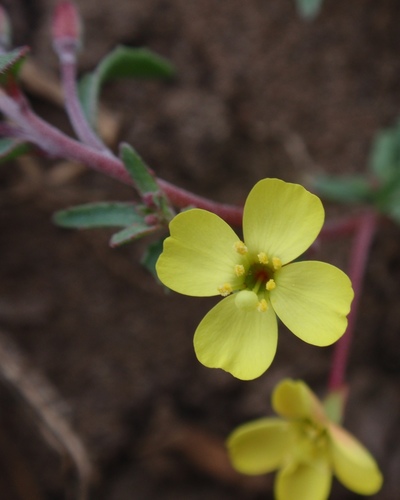
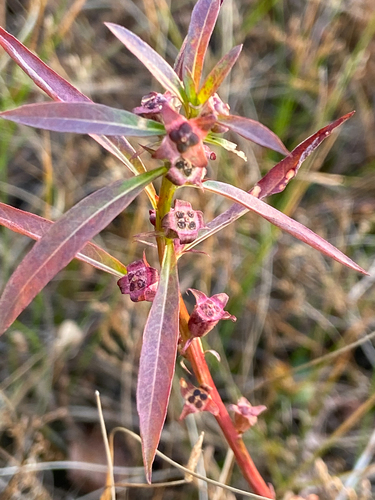
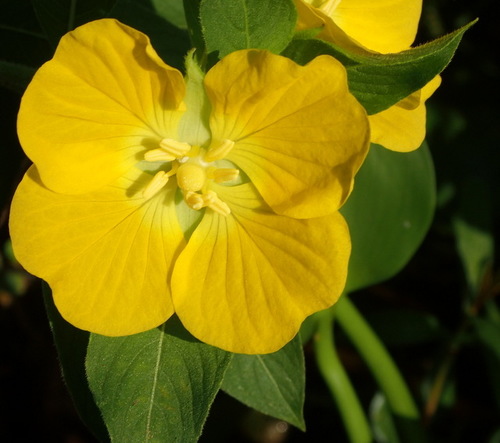
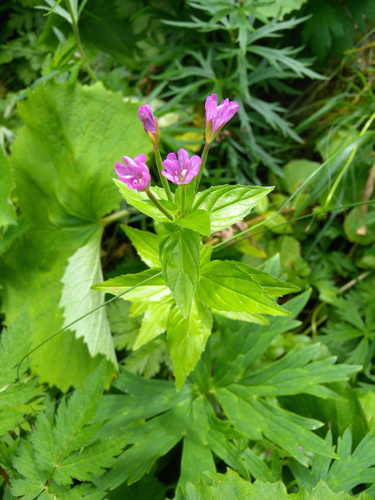
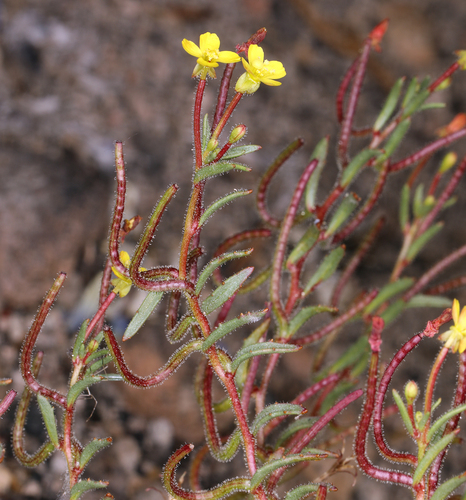
Camissonia contorta (Douglas) Kearney is a species of flowering plant in the Onagraceae family, commonly known as the plains evening primrose. This annual herb grows a slender, bending to curling stem that may be red or green, and is sometimes hairy. The stem can reach up to 30 centimeters long, growing either erect or spreading out. Its blue-green leaves are linear to very narrowly oval in shape, and measure up to 3.5 centimeters long. Nodding inflorescences hold one or more small flowers, each with bright yellow petals up to half a centimeter long; petals sometimes have small red dots near their bases. The fruit is a capsule around 3 centimeters long that contains 50 to 100 tiny seeds. The species' range extends from its southern limit in California's Transverse Range, north through the U.S. states of Oregon, eastern Idaho, and eastern Washington, to its extreme northern limit on Vancouver Island in British Columbia, Canada. Camissonia contorta occurs in three Köppen climate types: BSk (cold semi-arid), Csa (hot summer Mediterranean), and Csb (warm summer Mediterranean). It is a strict edaphic endemic, meaning it grows only on sandy soils. These sandy soils can form from a wide variety of parent rock types, including sandstone, greywacke, chert, granite, and rhyolite, especially rhyolite-derived volcanic ash and pumice. The species is most common and abundant in moderately disturbed sandy soils, particularly alluvial deposits along rivers shaped by water, and sand blow outs shaped by wind. It grows in sunny, open gaps between shrubs and trees. In British Columbia, Canada, Camissonia contorta is ranked S1 and listed as Critically Endangered. In this province, the species occurs mainly on Vancouver Island, along the immediate coastline from Metchosin north through Victoria to Sidney; the Köppen climate for Victoria is Csb. Its coastal Vancouver Island habitat is made up of semi-stable sandy flats and dunes located no more than 15 meters above sea level. These populations are the northernmost known for the species, marking the extreme northern limit of its range. Because these are the only Canadian populations of the species at its extreme northern range limit, it is classified as locally rare and endangered. Across the rest of its range, however, Camissonia contorta is locally common to abundant, reaching its highest abundance in California. It has no protected list status in the United States and is not considered rare there.