About Cameraria ohridella Deschka & Dimić, 1986
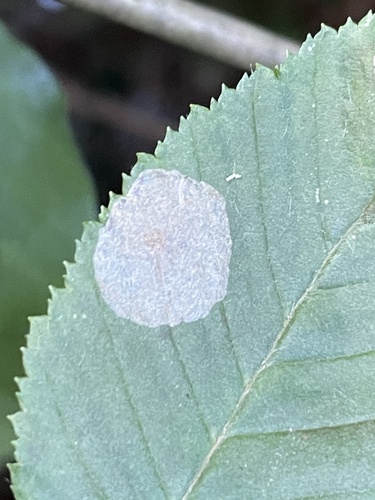
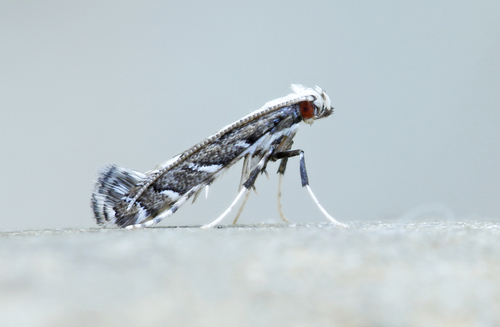
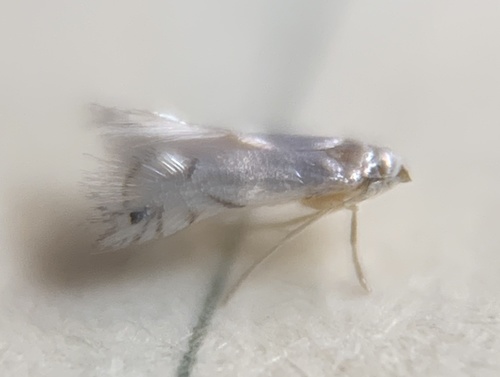
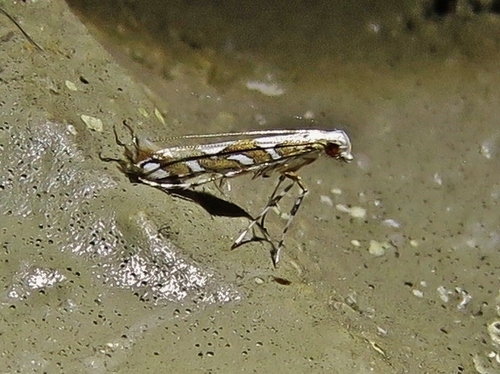
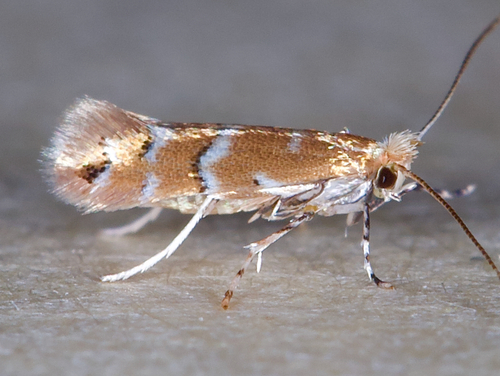
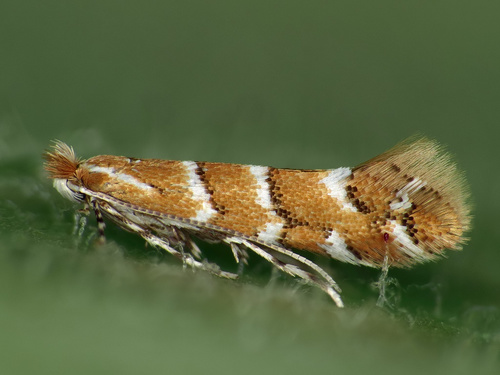
Adult Cameraria ohridella moths reach up to 5 millimeters (3⁄16 inch) in length. They have shiny, bright brown forewings marked with thin silvery white stripes, and dark grey hindwings edged with long fringes. Each female lays between 20 and 40 eggs individually on the upper surface of host leaves. Eggs hatch 2–3 weeks after being laid. Larvae go through five feeding instars, followed by two prepupal spinning phases before entering the pupal stage. The first instar creates a small leaf mine parallel to a leaf vein, and feeds on sap rather than leaf tissue. By the third instar, the mine reaches approximately 8 millimeters in diameter. Later instars continue expanding the mine, and a single mine can grow to cover several square centimeters. Larvae begin pupation around four weeks after eggs hatch. Unless pupae hibernate in the mine, adults emerge approximately two weeks after pupation starts. In severe infestations, individual mines merge and can cover almost the entire area of a leaf. Merged mines cause high competition for space and food between larvae, which can lead to high moth mortality. This species can produce up to five generations per year in hot, dry weather. In western Europe, the moth produces an average of three generations per year. The final generation of each year pupates for more than six months to survive winter. Pupae are extremely frost tolerant, and have been recorded surviving temperatures as low as −23 °C (−9 °F). This frost tolerance allows populations to increase even after harsh winters. Leaf damage caused by the horse-chestnut leaf miner resembles leaf damage from the fungus Guignardia aesculi on horse-chestnut trees. The two types of damage can be distinguished because fungal infection spots are typically outlined by a visible yellow band, which miner mines lack. C. ohridella pupae can be confused with pupae from the genus Phyllonorycter. They can be told apart because C. ohridella pupae do not have a cremaster, and have strong lateral spines on the first five abdominal sections. Cameraria ohridella has been recorded in Albania, Austria, Belgium, Belarus, Bosnia and Herzegovina, Bulgaria, Croatia, the Czech Republic, Denmark, England and Wales, Estonia, Finland, France, Germany, Greece, Hungary, Ireland, Italy, Kosovo, Latvia, Liechtenstein, Lithuania, Luxembourg, Moldova, Montenegro, the Netherlands, North Macedonia, Poland, Serbia, Romania, Russia, Slovakia, Slovenia, Spain, Sweden, Switzerland, Turkey and Ukraine. While horse-chestnut trees naturally grow mostly above 700–1,000 meters (2,300–3,300 feet), the moth thrives in well-watered low-elevation locations such as city parks, and does not survive well in hotter regions of Europe, for example Spain. The moth has achieved a very rapid dispersal rate across Europe, spreading 60 kilometers (40 miles) per year, a spread likely greatly aided by vehicular transport.