About Camelus bactrianus Linnaeus, 1758
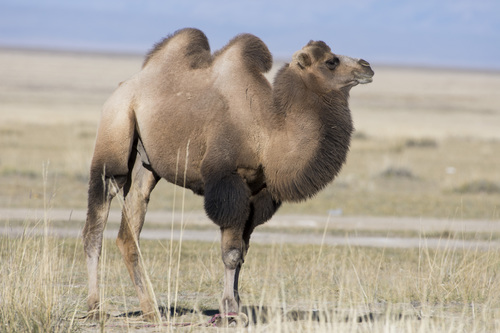
The Bactrian camel (Camelus bactrianus Linnaeus, 1758) is the largest mammal in its native range and the largest living camel, though it has a shorter shoulder height than the dromedary. Its shoulder height ranges from 160 to 180 cm (5.2 to 5.9 ft), with an overall height of 230 to 250 cm (7.5 to 8.2 ft). Head-and-body length measures 225–350 cm (7.38–11.48 ft), and tail length is 35–55 cm (14–22 in). Average height measured at the top of the humps is 213 cm (6.99 ft). Body mass ranges from 300 to 1,000 kg (660 to 2,200 lb): males average around 600 kg (1,300 lb), while females average around 480 kg (1,060 lb). This species has a long, wooly coat that varies in color from dark brown to sandy beige. A mane and beard of long hair up to 25 cm (9.8 in) long grows on the neck and throat. Its shaggy winter coat is shed extremely quickly, with large sections peeling off all at once, giving the appearance of a sloppy shearing. The two humps on its back are made up of fat, contrary to the common misconception that they store water. Its face follows the typical camelid shape: long and somewhat triangular, with a split upper lip. Long eyelashes and sealable nostrils work together to block dust during the frequent sandstorms that occur in the species' natural range. Each foot has two broad toes with undivided soles that can spread widely, an adaptation for walking on sand. The feet are very tough, suited to survival in extreme environments. Bactrian camels are migratory, and their natural habitat spans rocky mountain massifs, flat steppe, arid desert (most commonly the Gobi Desert), stony plains and sand dunes. Habitat conditions are extremely harsh, with sparse vegetation, limited water sources, and extreme temperatures. The Bactrian camel's coat allows it to withstand winter temperatures as low as −30 °C (−22 °F) and summer temperatures up to 50 °C (122 °F). The species' distribution is tied to water availability: large groups gather near rivers after rain, at the foot of mountains where they can get water from springs in summer, and from snow in winter. Bactrian camels are induced ovulators, meaning they ovulate after insemination (semen is inserted into the vagina); ovulation is induced by the seminal plasma, not the spermatozoa themselves. 87% of females ovulate after insemination: 66% ovulate within 36 hours, and the remaining ovulate by 48 hours, matching the timeline for natural mating. The minimum volume of semen required to trigger ovulation is approximately 1.0 ml. Males often become quite violent during mating season, and may bite, spit, or attempt to sit on other male camels. The age of sexual maturity varies, but is typically reached between 3 and 5 years old. Gestation lasts around 13 months. Bactrian camels produce one calf, or occasionally two, and females can give birth to a new calf every other year. Young Bactrian camels are precocial: they are able to stand and run shortly after birth, and they are fairly large, with an average birth weight of 36 kg (79 lb). Calves are nursed for about 1.5 years. A young calf stays with its mother for three to five years, until it reaches sexual maturity, and often helps raise the mother's subsequent offspring during this time. Wild Bactrian camels sometimes breed with domesticated or feral Bactrian camels. Bactrian camels have been domesticated for thousands of years, and are widely bred by pastoralist and agricultural communities across Central Asia, the Middle East, and parts of China and Mongolia. Breeding practices differ by region, but most focus on selecting for traits including hardiness, milk production, load-bearing ability, and temperament. In Mongolia, herders have traditionally managed breeding through selective mating during the rutting season, often using older, experienced bulls known for their vigor and fertility. These males are isolated with females to encourage mating and reduce aggression toward other camels. In Iran and parts of Afghanistan, camel breeding is commonly integrated into mixed farming systems, where camels provide transport and milk alongside other livestock. Semen collection and artificial insemination techniques are increasingly used in breeding programs in Central Asia, particularly in Kazakhstan and Uzbekistan, to improve genetic stock and ensure ovulation timing aligns with optimal conditions for conception. In China’s Xinjiang region, both government-supported operations and private breeders run large-scale camel farms, focused on conserving the genetics of domesticated Bactrian camels and improving reproductive efficiency. Advances in veterinary care, nutritional supplementation, and controlled breeding environments have increased calving rates in recent decades. Across all these regions, breeding cycles are timed to match favorable seasonal conditions to maximize calf survival. Female camels are usually bred every two years to allow full recovery after gestation and lactation, although higher-frequency breeding is sometimes practiced under intensive management systems. Offspring are commonly used for transportation, wool production, or sold in local markets, forming a critical part of the livelihood for many camel-rearing communities. The Indian Army uses Bactrian camels to patrol Ladakh. After carrying out trials and a comparative study with single-humped camels brought from Rajasthan, it was concluded that the double-humped Bactrian camel is better suited for this patrol task. Colonel Manoj Batra, a veterinary officer of the Indian Army, stated that double-humped camels "are best suited for these conditions. They can carry loads of 170 kilograms (370 lb) at more than 17,000 feet (5,200 m) which is much more than the ponies that are being used as of now. They can survive without water for at least 72 hours." The Russian Ground Forces has used Bactrian camels in the 2022–present Russo-Ukrainian war to carry heavy loads such as ammunition and supplies to the frontline. Russian forces have been reported to use camels for transport as early as February 2025. On 28 October 2025, the Ukrainian Ground Forces captured a camel that had been deserted by Russian forces during a Ukrainian counteroffensive near Kharkiv.