About Camellia sasanqua Thunb.
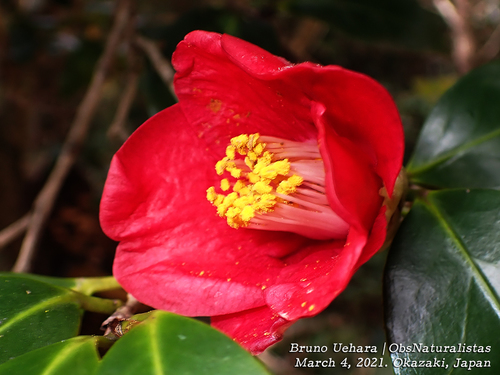
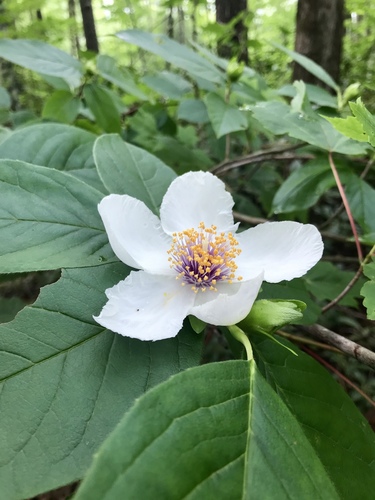
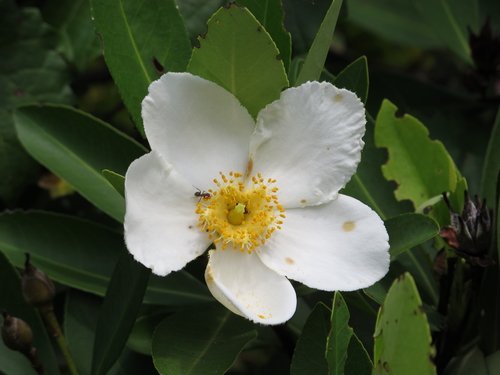
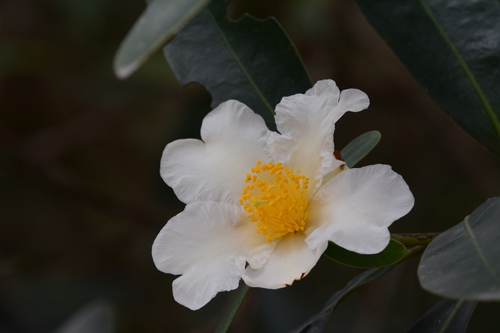
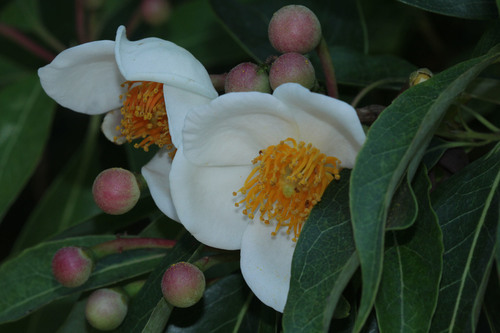
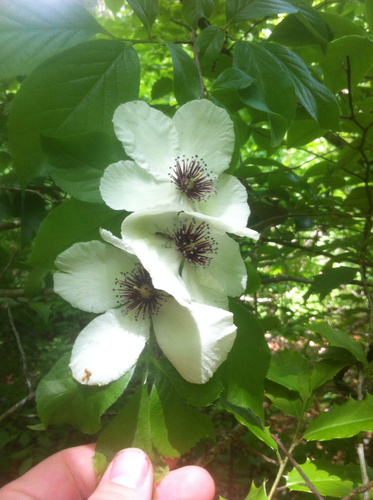
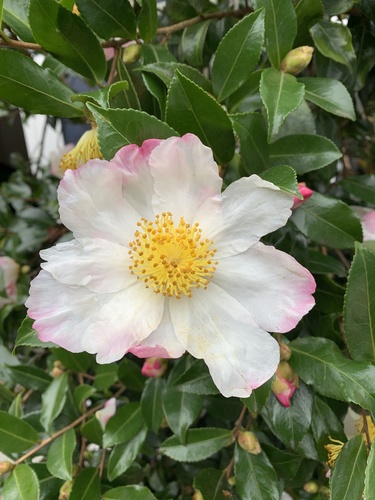
Camellia sasanqua, commonly known as sasanqua camellia, is a species of Camellia native to southern Japan, found in Kyushu, the Ryukyu Islands and Shikoku. It usually grows at altitudes up to 900 m (3,000 ft). This evergreen shrub grows to 5 m (16 ft) tall, with broad, elliptic leaves that are 3–7 centimetres (1.2–2.8 in) long and 1.2–3 centimetres (0.5–1.2 in) broad, with finely serrated margins. Its flowers are 5–7 centimetres (2.0–2.8 in) in diameter, with 5 to 8 petals ranging from white to dark pink. In Japan, this plant is called Sazanka (サザンカ, 山茶花). Cultivars of Camellia sasanqua began appearing at the start of the Edo period, and the first record of the plant’s cultivars was made by Ihei Ito (1695–1733). It was unknown in western society until 1820, when Captain Richard Rawes of the East Indiaman Warren Hastings brought Camellia sasanqua var. stricata to his relation Thomas Carey Palmer of Bromley in Kent. In 1869, Dutch traders imported additional specimens into Europe. It has now been introduced to Australia, New Zealand and the United States. Camellia sasanqua has a long history of cultivation in Japan for practical rather than decorative reasons. Its leaves are used to make tea, while its seeds or nuts are used to produce tea seed oil, which is used for lighting, lubrication, cooking and cosmetic purposes. Tea oil from this plant has a higher calorific content than any other naturally available edible oil in Japan. Camellia sasanqua is valued in gardens for its attractive glossy green foliage, and fragrant single flowers that range in color from white to deep pink and bloom extremely early in the season. Many cultivars have been selected, and 'Crimson King', 'Hugh Evans' and 'Jean May' have earned the Royal Horticultural Society's Award of Garden Merit.