About Camaricus formosus Thorell, 1887
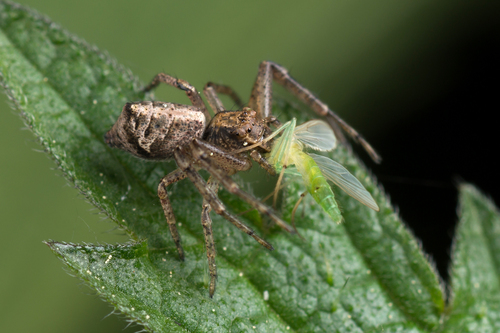
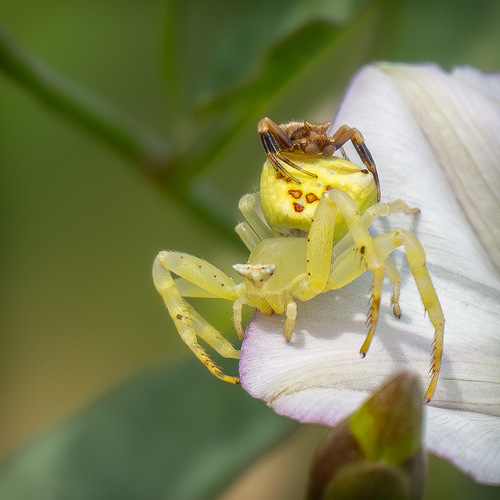
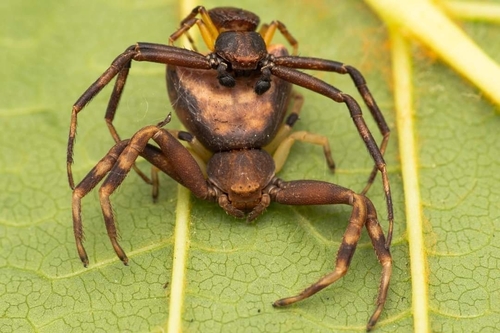
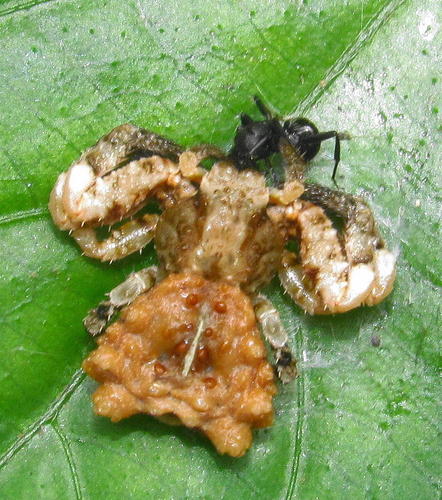
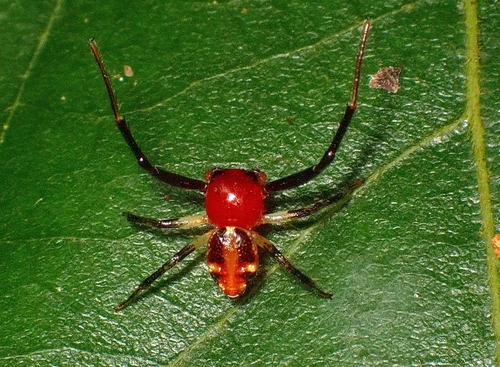
Camaricus formosus is a species of crab spider that displays the sexual dimorphism typical of many crab spider species. Females are larger than males, with a total body length of 7 to 9 mm, while males reach 4 to 6 mm in total length. The species' cephalothorax is red, covered in black hairs, and marked with brown and black patches. The anterior region and lateral sides of the cephalothorax have prominent deep brown or black patches, but the central brown patch is sometimes absent in male specimens. This species has eight eyes arranged in two rows, with the posterior row slightly longer than the anterior row. Its abdomen is dark brown, longer than it is wide, covered with black hairs, and marked with distinct chalk-white bands that run both lengthwise and along its sides. The epigyne and other reproductive structures of this species have been thoroughly described in existing taxonomic literature. The legs of Camaricus formosus are robust, pale greenish in color, covered with hairs and spines, and marked with black patches; in males, the first and second pairs of legs may be entirely dark brown. Camaricus formosus has a broad distribution across South and Southeast Asia, ranging from India to Sumatra (Indonesia), China, and the Philippines. It has been specifically recorded from the Andaman and Nicobar Islands, West Bengal (India), Burma, and Sumatra. A 2017 new country record added Bangladesh to the species' confirmed range. This spider is known to live in rice fields, and it is counted among the spider fauna that occupies riceland ecosystems in South and Southeast Asia.