About Calytrix leschenaultii (Schauer) Benth.
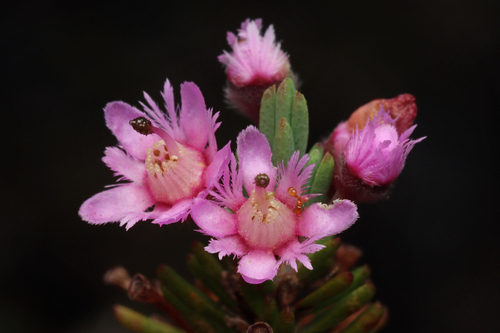
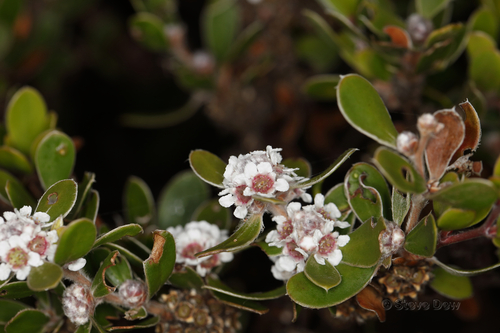
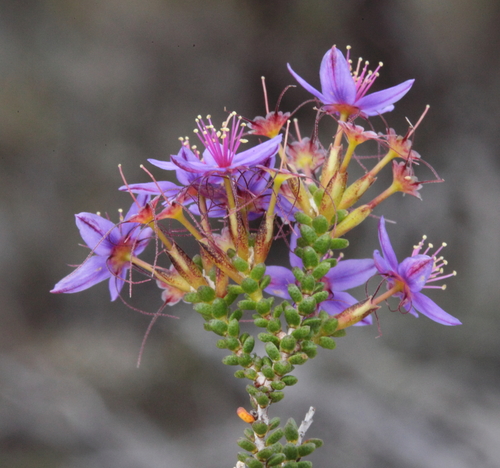
Calytrix leschenaultii (Schauer) Benth. is a mostly glabrous shrub that typically grows to a height of 0.15–1 m (5.9 in – 3 ft 3.4 in). Its leaves are egg-shaped, elliptic, lance-shaped or linear, 1–4 mm (0.039–0.157 in) long and 0.5–1.6 mm (0.020–0.063 in) wide, borne on a petiole 0.1–0.5 mm (0.0039–0.0197 in) long, and there are no stipules. Flowers grow on a funnel-shaped peduncle 0.6–2.5 mm (0.024–0.098 in) long, with narrowly elliptic to spoon-shaped bracteoles 3.75–7.0 mm (0.148–0.276 in) long that have egg-shaped to more or less round lobes 1.5–2.9 mm (0.059–0.114 in) long. The floral tube has 10 ribs, is fused to the style, and measures 5.75–11 mm (0.226–0.433 in) long. Sepals are broadly egg-shaped, 1.00–1.75 mm (0.039–0.069 in) long and 1.3–2.25 mm (0.051–0.089 in) wide, with an awn up to 10 mm (0.39 in) long. Petals are purple, mauve, violet or pink with a white or yellowish base, lance-shaped to elliptic, 4.5–7.5 mm (0.18–0.30 in) long and 2.0–3.75 mm (0.079–0.148 in) wide. There are 6 to 40 white or yellowish stamens per flower. Flowering occurs mainly from June to November, with a peak in September and October. This species is found in a wide range of habitats including heath, woodland, heathy scrub and shrubland, ranging from the Kalbarri district south-east to Israelite Bay. It occurs in the Avon Wheatbelt, Coolgardie, Esperance Plains, Geraldton Sandplains, Jarrah Forest, Mallee, Swan Coastal Plain, Warren and Yalgoo bioregions of south-western Western Australia. Outside of flowering season, this plant is rather plain. Its slightly scented, small oval leaves line spindly shoots in an alternate arrangement, in the same pattern as many other species in the myrtle family. The plant becomes distinctive when in full bloom. Its star-like flowers are vivid purple with white or yellow stamens, and fade to red. Although rarely cultivated, Calytrix leschenaultii is well adapted to tolerate the extremes of the Australian climate. Planted in a sunny spot with sandy soil, it can withstand both drought and frost. It is best propagated from cuttings rather than from seed.