About Calytrix flavescens A.Cunn.
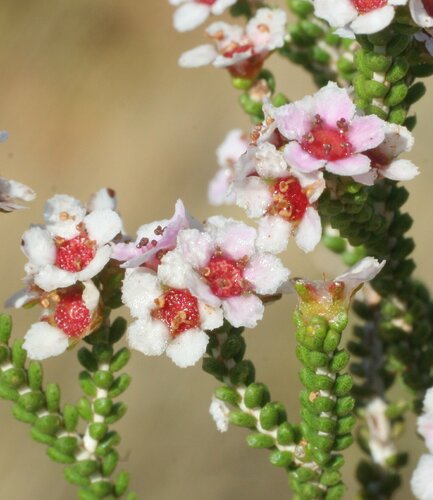
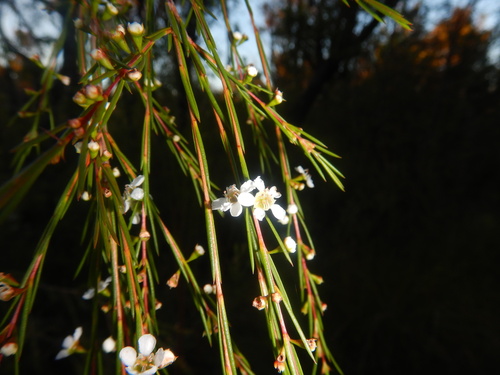
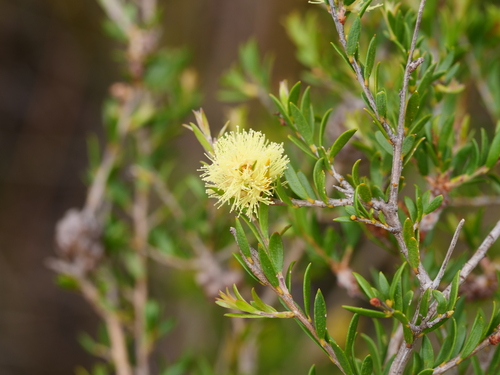
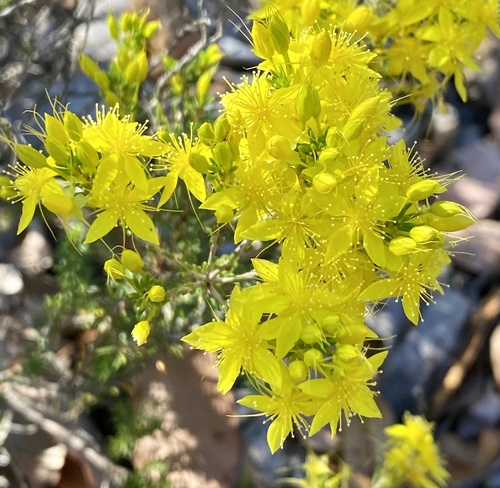
Calytrix flavescens A.Cunn., commonly called summer starflower, is a shrub that typically reaches a height of 30 to 80 cm (12 to 31 in). Its leaves are shaped linear to narrowly elliptic, most measuring 4–9 mm (0.16–0.35 in) long and 0.5–1.5 mm (0.020–0.059 in) wide, attached to a petiole 0.25–1.0 mm (0.0098–0.0394 in) long. Flowers are carried on a peduncle 0.6–1.25 mm (0.024–0.049 in) long, with egg-shaped to lance-shaped bracteoles 5–9 mm (0.20–0.35 in) long. The glabrous floral tube is 7–15 mm (0.28–0.59 in) long, fused to the style, and usually has 10 ribs. The sepals are fused at their base, with more or less round to broadly egg-shaped lobes that are 1.5–2.75 mm (0.059–0.108 in) long and 1.5–2.5 mm (0.059–0.098 in) wide, each bearing an awn up to 14 mm (0.55 in) long. The petals are glabrous, yellow, and egg-shaped to lance-shaped, measuring 5.5–10 mm (0.22–0.39 in) long and 3.5–4.0 mm (0.14–0.16 in) wide. Around 35 to 60 stamens arranged in several rows are present in each flower. Flowering usually takes place between October and January. This species grows on sand plains, gentle slopes, and occasionally in winter-wet areas, across sandy soils over granite, laterite, or sandstone. Its range extends from the Arrowsmith River district south to the Blackwood River district, within the Avon Wheatbelt, Esperance Plains, Geraldton Sandplains, Jarrah Forest, Mallee, Swan Coastal Plain and Warren bioregions of south-western Western Australia.