About Calystegia silvatica (Kit.) Griseb.
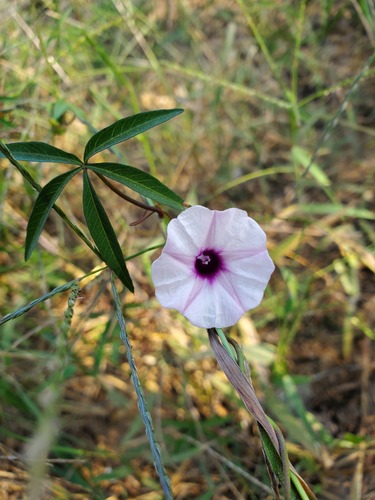
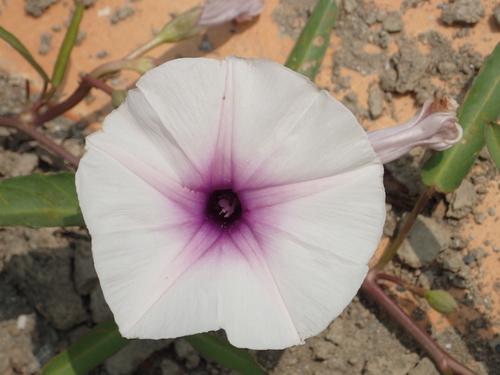
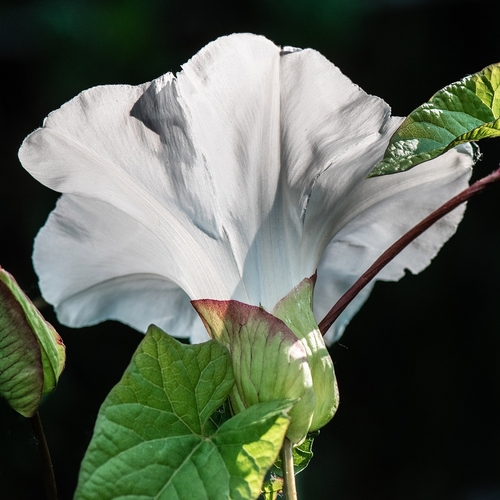
Large bindweed (Calystegia silvatica (Kit.) Griseb.) is a hairless herbaceous perennial that twines counter-clockwise, growing up to 5 meters tall. Its leaves grow alternately along the spiralling stem on petioles that reach up to 15 cm long. Leaves are simple, arrowhead-shaped (sagittate), dull green on the upper surface and paler below, growing up to 15 cm long and up to 9 cm wide. Flowers are white, sometimes only with a narrow pink band on the outer surface, and bloom from late spring to the end of summer (between July and September in northern Europe). Before opening, flower buds are enclosed by large green ovate bracteoles that measure 4.8 cm long and are pouched at the base; the bracteoles overlap strongly when the flower opens. Fully open flowers are trumpet-shaped and 6–9 cm in diameter. After flowering, the plant produces an almost spherical fruit capsule that measures 1 cm in diameter, hidden by the plant’s bracts. The capsule holds 2 to 4 large, dark brown or black seeds shaped like quartered oranges. Large bindweed can be distinguished from the related hedge bindweed (Calystegia sepium) by floral and vegetative traits. In flowering plants, the difference is in the bracteoles that grow below the flower and wholly or partially surround the sepals. Large bindweed has shorter, wider bracteoles that overlap at their meeting point, while hedge bindweed has narrower, longer bracteoles that leave a gap between them, through which sepals can be seen. When plants are not flowering, the two species can be told apart by the shape of the leaf sinus, the gap between the lobes at the base of the leaf. Large bindweed has a U-shaped sinus, while hedge bindweed most often has a V-shaped sinus.