About Calyptraea chinensis (Linnaeus, 1758)
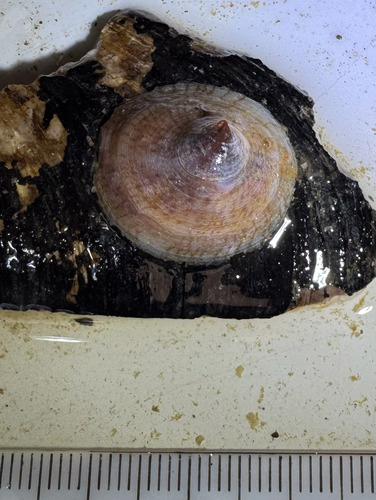
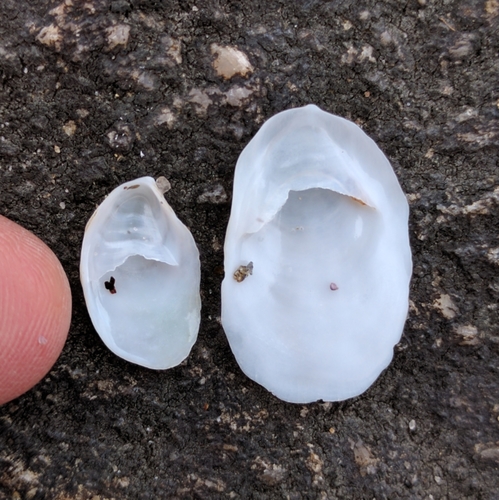
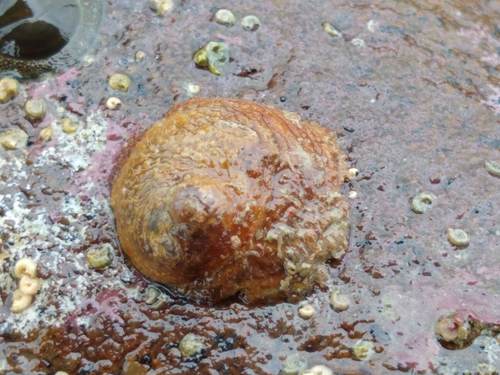
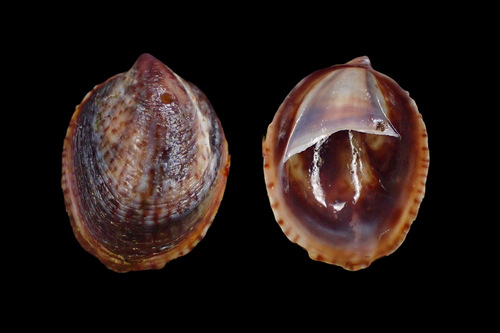
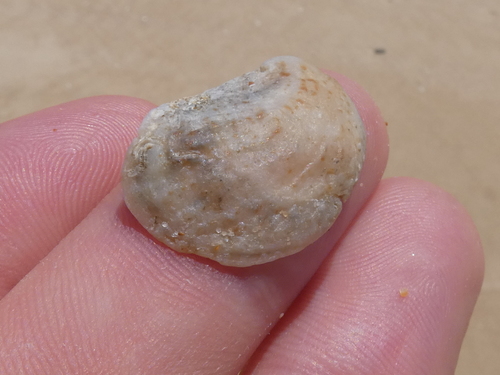
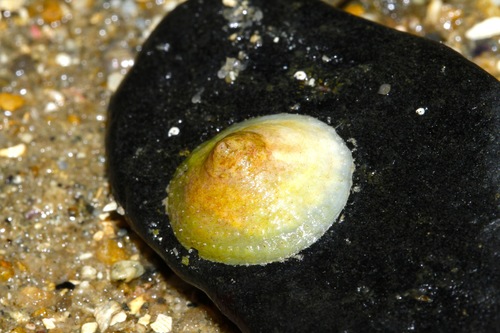
The thin shell of Calyptraea chinensis forms an almost symmetrical cone, shaped similar to a Chinese conical hat. It measures 7 mm in height, and 15–21 mm in width. This species has an internal partition with a spirally curved edge that extends from the shell's apex to its margin, and this structure partly covers the aperture. The internal shelf created by this partition easily distinguishes this species from true limpets. Its aperture is round, and shaped to fit the substrate it attaches to. The shell is creamy white, and its inner surface is glossy. Calyptraea chinensis is a filter feeder that uses mucus to bind fine food particles. Like all slipper limpets, it is a protandrous hermaphrodite, but the specific stages of its sex change from male to female have not been clearly defined. Unlike the American slipper limpet Crepidula fornicata, this species does not form stacked groups. Males and females only meet to copulate. This species does not have a pelagic larval phase. The veliger larval stage develops inside capsules that are attached to the substrate, and these capsules are guarded under the parent's shell. The young hatch as crawling post-veliger larvae. Calyptraea chinensis is distributed across North-West Africa, the Mediterranean, the Black Sea, the Atlantic Ocean, and the northern and western coasts of Britain and Ireland. It is absent from the North Sea and the English Channel. These small snails live in the littoral and sublittoral zones of sheltered rocky shores, and also in muddy or silty areas, as long as they can cling to a hard substrate such as stones, living oysters, and other shells. Fossil specimens of Calyptraea chinensis are known from the Pliocene and Early Pleistocene periods.