About Calyptorhynchus banksii (Latham, 1790)
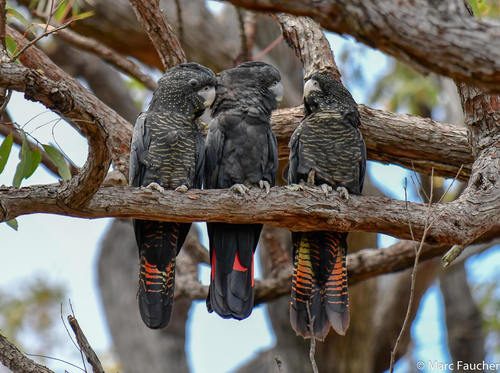
Red-tailed black cockatoos are roughly 60 centimetres (24 in) long and sexually dimorphic. Males have entirely black plumage with a prominent black crest formed from elongated feathers of the forehead and crown. Their bill is dark grey, and their tail is black with two bright red lateral panels. Males weigh between 670 and 920 grams (1.48 and 2.03 lb). Females are black, with yellow-orange stripes across the tail and chest, and yellow spots that grade to red on the cheeks and wings. Their bill is pale and horn-coloured, and their underparts have fine yellow barring over a black base. Females are slightly smaller, weighing 615–870 grams (1.356–1.918 lb). Like other cockatoos and parrots, red-tailed black cockatoos have zygodactyl feet: two toes face forward, and two face backward. This foot structure lets them grasp objects with one foot while standing on the other for feeding and manipulation. Along with nearly all other cockatoos and most parrots, black cockatoos are almost exclusively left-footed. Juvenile red-tailed black cockatoos look similar to females until they reach puberty at around four years of age, but they have paler yellow barred underparts. As the birds mature, males gradually replace their yellow tail feathers with red ones, and the full process takes approximately four years. Like other cockatoos, red-tailed black cockatoos can be very long-lived when kept in captivity. In 1938, ornithologist Neville Cayley reported an individual over fifty years old housed at Taronga Zoo. Another individual, kept at London Zoo and Rotterdam Zoo, was 45 years and 5 months old when it died in 1979. Several distinct calls of red-tailed black cockatoos have been recorded. The species' contact call is a rolling metallic krur-rr or kree, which can travel long distances and is always given while the bird is flying. Its alarm call is sharp. Displaying males produce a vocal sequence of soft growling followed by a repetitive kred-kred-kred-kred. The red-tailed black cockatoo mainly lives across the drier regions of Australia. It is widespread and abundant across a wide band spanning the northern half of the country, where it has been classified as an agricultural pest. It has more isolated populations in southern Australia. It occupies a wide range of habitats, from shrublands and grasslands through eucalypt, sheoak and Acacia woodlands, to dense tropical rainforests. The species depends on large, old eucalypts for nesting hollows, though the specific eucalypt species used vary across different parts of Australia. Red-tailed black cockatoos are not fully migratory, but they do carry out regular seasonal movements in different parts of Australia. In northern parts of the Northern Territory, the birds mostly leave high-humidity areas during the summer wet season. In other parts of the country, the cockatoos' seasonal movements generally track available food sources, a pattern that has been recorded in Northern Queensland and New South Wales. In southwest Western Australia, both living subspecies follow a north-south movement pattern: subspecies naso moves northward after breeding, while movements of subspecies samueli in the wheatbelt can be irregular and are not linked to the seasons.