About Calypso bulbosa (L.) Oakes
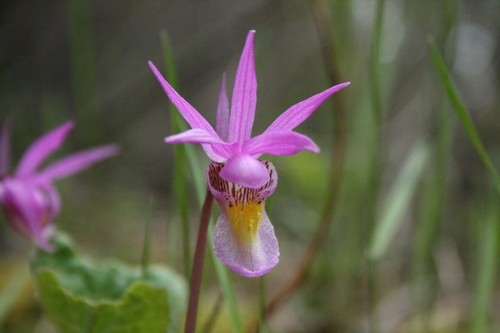
Calypso bulbosa (L.) Oakes is a low-growing herbaceous orchid that grows from a nearly egg-shaped underground storage corm, which is covered by dead leaf sheaths and produces elongated roots. Mature plants reach a height of 8 to 20 cm. Each plant grows a single leaf, which measures 1 to 6.5 cm long and 1.2 to 5.2 cm wide. The leaf can be nearly circular, suborbiculate, or egg-shaped ovate, with a typically cordate, heart-like indented base. It is attached to the plant by a very long petiole, or leaf stalk. The leaf emerges in autumn, stays green through the winter, and withers shortly after the plant blooms. The plant produces a single purple-pink flower that is hermaphroditic, zygomorphic, and tripartite. The protruding petals and sepals range from pink to purple, and measure 10 to 12 mm long and 2 to 4 mm wide. The lip, also called the labellum, ranges from white to pink with pink or yellow spots. It contains a wide, shoe-shaped cavity at its back and measures 15 to 25 mm long. Flowering usually occurs in May and June, typically after snowmelt. The plant forms a new corm each year, and corms from one or two previous years can remain attached and firm. Plants rarely live longer than five years. This species has a circumpolar range across the northern hemisphere. In Europe, it is found only in Sweden, Finland, the Baltic states, and northern European Russia. In North America, it occurs in California, the Rocky Mountain states, most of the northernmost United States, and most of Canada. In Asia, it is found in China, Mongolia, Korea, and Japan. It grows in subarctic swamps and marshes, as well as shady locations within subarctic coniferous forests. In areas near Banff, Alberta, Calypso bulbosa is pollinated by bumble bees from the subgenera Bombus (Pyrobombus) and B. Psithyrus. It uses pollination by deception: it attracts insects with anther-like yellow hairs at the entrance of its flower pouch and forked nectary-like structures at the end of the pouch, but it produces no nourishing nectar. Insects quickly learn not to revisit the flowers, and this pressure to avoid recognition may contribute to small variations in the flower's appearance. Attempts to cultivate this species in gardens are not successful, and transplanting usually kills the plant. This is because the species depends on mycorrhizal relationships with soil fungi, which are lost during transplantation. Historically, the corms of Calypso bulbosa have been used as a food source by Indigenous North American peoples. The Nlaka'pamux people of British Columbia have used the corms to treat mild epilepsy.