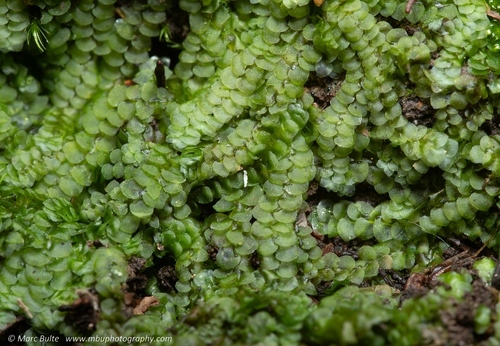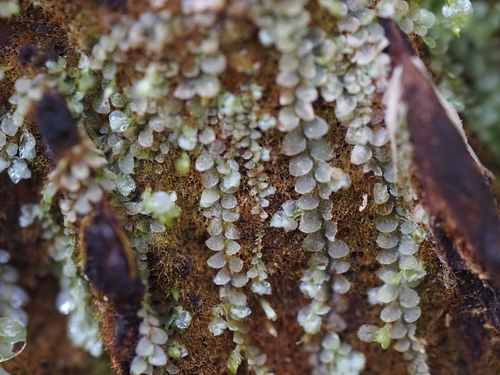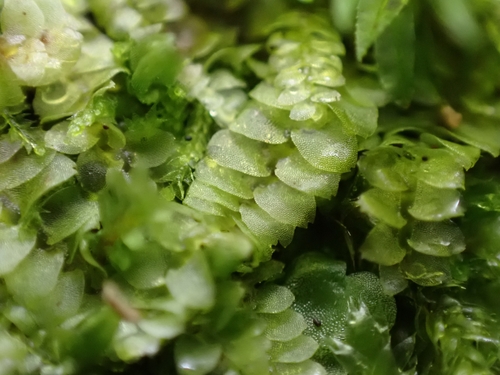
About Calypogeia fissa (L.) Raddi
Calypogeia fissa (L.) Raddi was first published in Jungermanniogr. Etrusca: 33 in 1818. Its basionym is Mnium fissum L., published in Sp. Pl. 1: 1114 in 1753 (nom. conserv). The original material is from Great Britain, Surrey, Dorking, but it has not been seen.
Calypogeia fissa is one of the oldest names in Calypogeia, and several taxa were split from the original C. fissa s.l. The species appears to be restricted to Europe. In North America and the northwestern amphi - Pacific (Commanders, Kamchatka, Kurils, Sakhalin), C. neogaea (R.M. Schust.) Bakalin substitutes for C. fissa. Stotler and Crandall - Stotler (2017: 591) stated that C. fissa "likely does not occur in North America and specimens identified as such likely belong to C. neogaea". Although C. fissa was recorded in Japan in the past, Hattori (1952) doubted this record, and it has never been mentioned in the Japanese flora since. In temperate East Asia, its nearest morphological ally is C. tosana.
Even relatively recently, Calypogeia fissa has been recorded on the East Asian mainland. Singh and Nath (2007a) recorded it in the East Khasi Hills and West Khasi Hills, and presumably also in Sikkim and Darjeeling (based on other literature records not cited). Bapna and Kachroo (2000) described its wide distribution in India. Wang et al. (2011) mentioned it in Taiwan; Fang et al. (1998) in Jiangxi. The records for Yunnan and Hunan are based on Nicholson et al. (1930). It is hypothesized that most records of C. fissa may be misidentifications of C. tosana. The authors believe that 'true' Calypogeia fissa is restricted to Europe (confirmed by Buczkowska et al. 2018) and should be excluded from the Sino - Himalayan Calypogeia flora. Additionally, in Europe, Calypogeia fissa consists of two genetically distinct taxa (Buczkowska et al. 2011) that may need taxonomic revision.