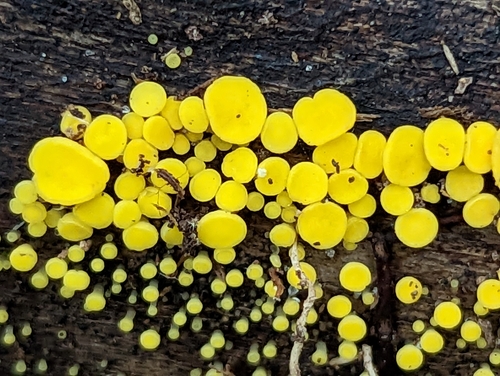
About Calycina citrina (Hedw.) Gray
Calycina citrina (Hedw.) Gray fruit bodies start as closed spherical globules before expanding. These small, smooth, bright yellow fruit bodies are typically less than 3 mm (1⁄8 in) in diameter and up to 1 mm (1⁄32 in) high, with a shallow cup- or disc-shaped form. The inner surface is smooth and bright yellow, while the outer surface is a paler yellow. Masses of spores are white in color. The stalk is broad, pale yellow, and short to nearly absent; when present, it is rarely more than 1 mm long. Fruit bodies may grow so numerous that their shapes become distorted from overcrowding. Dried fruit bodies are wrinkled and have a dull orangish-brown color. This fungus has no distinctive taste or odor, and is not edible. Its smooth spores are roughly elliptical, measuring 8–14 by 3–5 μm. Mature spores have one cross-wall and contain oil drops at either end. The spore-bearing asci measure 100–135 by 7–10 μm. Paraphyses are shaped like narrow cylinders with diameters up to 1.5 μm, and have rounded or somewhat club-shaped tips. β-Carotene is the main pigment that gives the fruit body its yellow color. As a saprobic species, Calycina citrina gets nutrients by breaking down complex organic molecules into simpler molecules. Its fruit bodies typically grow in dense clusters on the surface of rotten wood, especially from deciduous trees, and most commonly beech. They have also been recorded growing on the fruit bodies of the polypore fungus Daedaleopsis confragosa. In one study of fungal succession during decay of a 120-year-old healthy beech tree uprooted by strong winds, C. citrina appeared on the wood around three years after the tree fell. It grew after early colonizing fungi including Quaternaria quaternata, Tubercularia vulgaris (the anamorph form of Nectria cinnabarina), and Bulgaria inquinans, and was followed by Stereum hirsutum and Nectria cinnabarina. This is a widespread fungus, recorded from North Africa, Asia, Europe, North America, Central America, South America, Australia, and New Zealand. It is one of the most common species among small discomycetes.

