About Calycanthus floridus L.
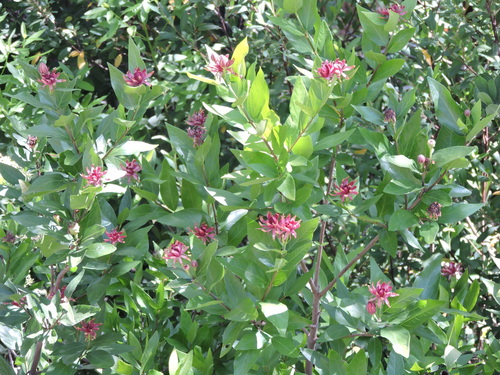
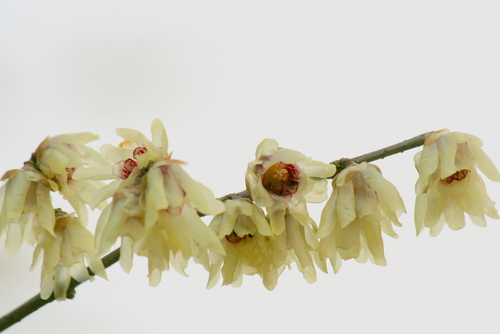
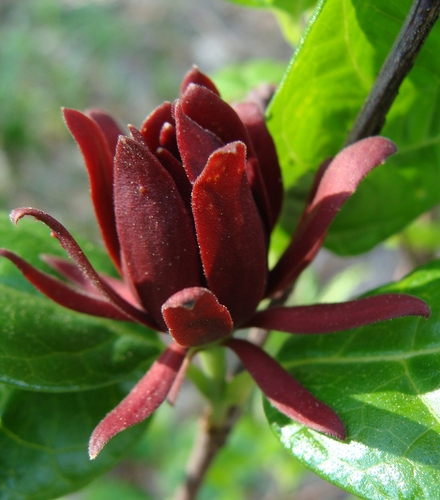
Calycanthus floridus L. is a shrub that reaches a height of 2 to 3 meters (6 to 9 feet). Its leaves are dark green on the upper surface and pale on the underside, with an ovate or elliptical shape that grows up to 15 centimeters (6 inches) long. The leaves are simple, have smooth entire margins, and are arranged oppositely along the stem. Its flowers are solitary, and range in color from reddish brown to reddish purple when they bloom in spring. Both the flowers and bruised leaves are aromatic. The flowers have a hypanthium longer than 0.8 inches (2 cm), and can be cylindrical, ellipsoid, pyriform, or globose in shape. Mature flowers have numerous tepals, which are either oblong-elliptic or obovate-lanceolate. The flowers are perfect, meaning they produce both stamens and carpels. There are numerous stamens, with connective tissue extending beyond the anthers, and numerous free carpels, each containing a single ovary in one locule. When mature, the fruits are indehiscent pseudocarps about 3 inches (8 cm) long and 2 inches (5 cm) in diameter. These fruits form inside the receptacle and contain numerous achenes, which are roughly 0.4 inches (10 mm) long and 0.2 inches (5 mm) in diameter. Calycanthus floridus is native to the eastern United States, and it is presumed to have been extirpated from Ohio. It prefers sunny habitats but can tolerate moderate shade, and grows well in areas with moist growing substrate. It is used in horticulture for its showy, fragrant blooms. The plant's bark is edible, and is reportedly used as a substitute for cinnamon. Flower petals are reportedly used to make medicinal tea. Strong caution is recommended for consumption, because an alkaloid found in the plant may cause heart convulsions. The viscous substance produced by the plant is reportedly used as a disinfectant. It is highly resistant to diseases and insects, though it is prone to infection by Agrobacterium tumefaciens, which causes crown galls to form on the stems. This plant is classified as a pollinator plant that supports and attracts beetles.