About Calvatia sculpta (Harkn.) Lloyd
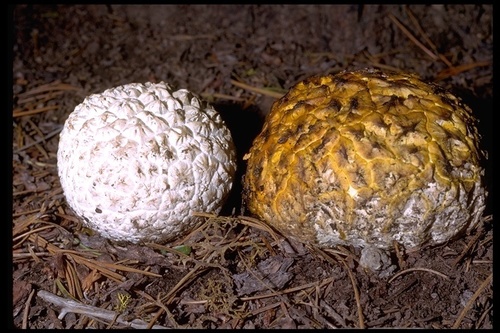
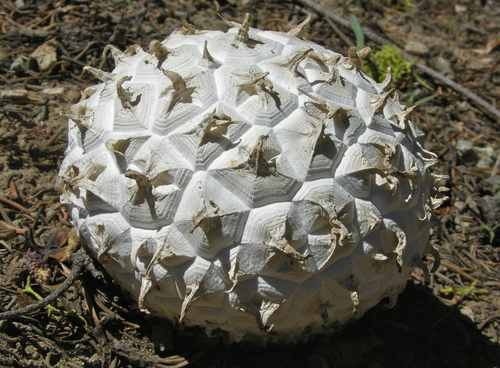
Calvatia sculpta produces white pear- or egg-shaped fruit bodies that measure 8 to 15 cm (3 to 6 in) tall by 8 to 10 cm (3 to 4 in) wide. Its outer tissue layer, called the exoperidium, is covered in distinctive long, pointed, pyramid-shaped warts. These warts may stand erect, bend over, and sometimes connect to other warts at their tips, and feature parallel horizontal lines toward their base. Mycologist David Arora has noted that C. sculpta looks like "a cross between a geodesic dome and a giant glob of meringue". As the fungus ages, the peridium sloughs off to expose a brownish spore mass. When young, the gleba—the inner flesh of the puffball—is firm and yellowish-white; it gradually becomes powdery and deep olive-brown as the fungus matures. The spores are roughly spherical, thick-walled, with a typical diameter of 3–6 μm, although some specimens collected in the United States range from 7.2 to 9.5 μm. They are covered in minute spines or warts. Scanning electron microscopy has shown that these spore ornamentations are typically 0.95 μm long. Spore ultrastructure is unique among Calvatia species, and it has been used to verify taxonomic groupings and confirm species status within the genus. Capillitia, the coarse, thick-walled hyphae found in the gleba, are septate, with branches that narrow toward the tips, and measure 3–8 μm in diameter. When grown in pure laboratory culture under certain conditions, C. sculpta can grow linear hyphal aggregates called mycelial strands. In these strands, older "leading" hyphae become enclosed by coiled layers of newer "tendril" hyphae. Mycelial strands act as conduits that transport water and nutrients across non-nutrient material, allowing the fungus to reach new food sources. They are also thought to be involved in forming fruit bodies and sclerotia. C. sculpta mycelia can be induced to form mycelial strands when a permeable physical barrier separates the mycelium from the agar substrate. Wide hyphae at the center of mycelial strands have torus-shaped, protein-dense structures on their cell walls; their function is currently unknown. The sculptured puffball grows alone or in small groups in forest duff. It is typically associated with high-elevation coniferous forests, above approximately 750 m (2,500 ft), growing on western North American mountains including the Sierra Nevada and the Cascade Range. In the United States, it is found in California, Oregon, Washington, and Idaho. An uncommon species, it produces fruit bodies throughout spring, summer, and fall during wet weather. While it is most commonly known from western North America, it was reported growing on sandy soil in Natal Dunes State Park, in the northeastern Brazilian state of Rio Grande do Norte, in 2008. The fruit bodies found there grew in association with roots of the native tree Eugenia brasiliensis. Several hypotheses have been proposed to explain this disjunct distribution: the species may have been present before the separation of the Americas; it may have been introduced to Brazil by human activity and adapted to the local environment; or North and South American populations may form a cryptic species complex—populations that look morphologically similar but are genetically distinct. The Brazilian population has not yet been genetically compared with North American specimens.