About Calvatia booniana A.H.Sm.
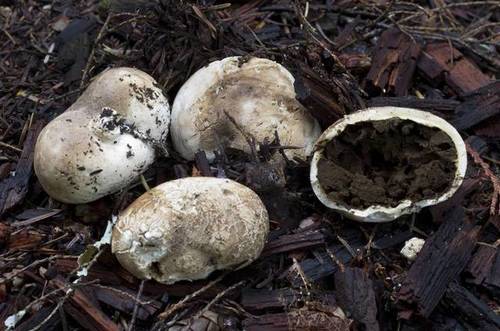
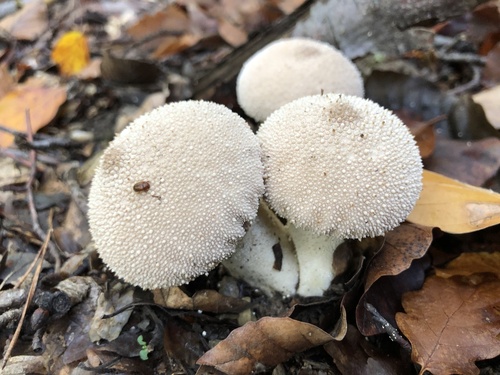
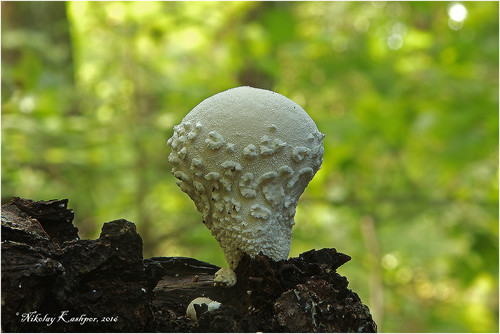
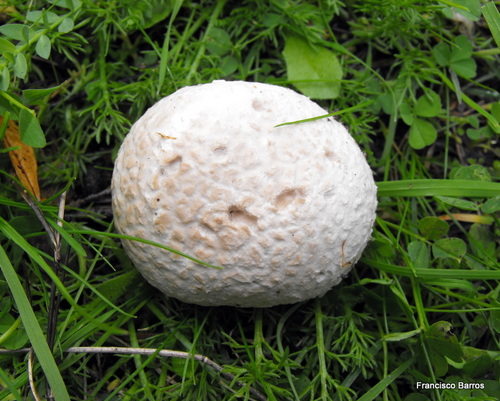
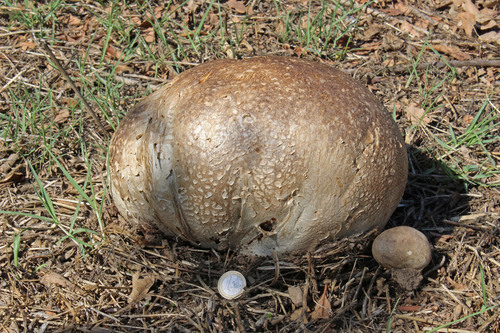
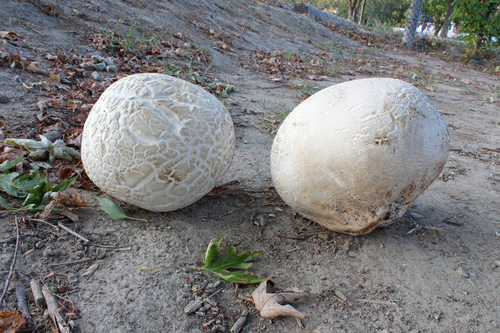
Calvatia booniana A.H.Sm., commonly known as the western giant puffball, produces fruit bodies that grow 10 to 70 centimetres (4 to 27+1⁄2 inches) in diameter, reaching the same large size as its close relative, the giant puffball found in eastern North America and Europe. Mature fruit bodies are at least 12 cm (4.7 in) across, with a round or flattened spherical shape and no stalk. The outer surface is white or tan; unlike the smooth exterior of giant puffballs, the western giant puffball is covered in plaques or large pointed warts. The interior flesh is first firm and white, then turns yellow and slimy, and finally becomes powdery as it matures. Unlike most puffballs, the western giant puffball undergoes three stages of asexual reproduction. Smaller western giant puffballs typically grow in clumps from the epidermal covering of a parent individual.
The western giant puffball grows on composted soil in sunny locations including meadows, fields, forests, roadsides, sagebrush flats, and pastures, similar to the giant puffball. In general, western giant puffballs occur west of the Rocky Mountains, while giant puffballs occur east of the Rocky Mountains. On the West Coast of North America, the western giant puffball is replaced by the giant puffball or a closely related species.
The western giant puffball is edible when its interior is completely white, but it may cause a laxative effect in some people. Any specimens with even traces of yellow or green inside are inedible. The species does not wash well, so trimming off most dirt is the best preparation; washing with water makes it too soggy for sautéing. It can be seasoned the same way as the giant puffball. It is good when cubed and cooked in soup, breaded and deep-fried, steamed, sautéed, or simmered like other mushrooms. Like the giant puffball, it does not dehydrate well, but it can be cooked first to prevent it from turning mushy, then frozen. After thawing, it should be cooked again. Its texture is similar to tofu or marshmallows, matching the texture of the giant puffball. Like many foodstuffs and other puffballs, not all individual specimens have the same taste.