About Calumma parsonii (Cuvier, 1825)
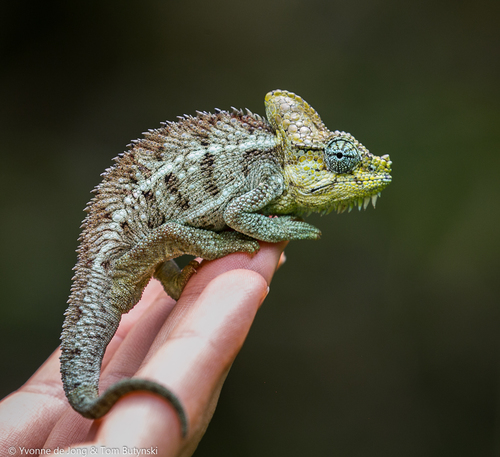
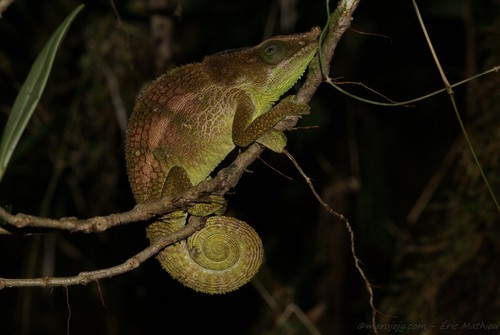
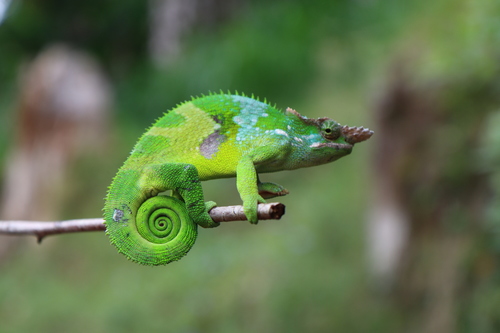
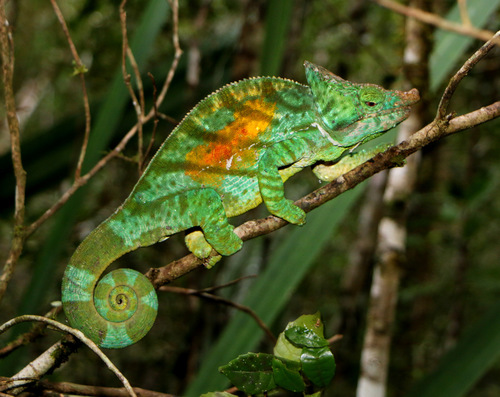
Parson's chameleon (scientific name Calumma parsonii (Cuvier, 1825)) is generally recognized as the world's heaviest chameleon, and one of the longest-bodied chameleon species. Only the Malagasy giant chameleon grows to a greater total length. Adult males typically weigh 500–700 g (18–25 oz), have a bony casque on the top of the head, and ridges that run from above the eyes to the nose, forming two warty horn-like projections. There are two widely recognized subspecies of Calumma parsonii. The widespread nominate subspecies, Calumma p. parsonii, occurs in both lowlands and mid-elevation areas. It lacks a dorsal crest (spines along the back ridge) and reaches up to 65 cm (26 in) in total length including the tail; while there are reports of individuals exceeding 80 cm (31 in), these remain unverified. The second subspecies is Calumma p. cristifer, which is restricted to mid-elevation areas in the Andasibe region. It has a small dorsal crest of small spines along the back, weighs less than the nominate subspecies, and generally reaches a maximum total length of 50 cm (20 in), though there are reports of individuals growing up to 60 cm (24 in). Four main male color variants are recognized within the nominate subspecies, but it is not clear if these should be classified as morphs or separated into additional subspecies; most researchers currently classify them as morphs, despite their separate geographic ranges, and the exact variant present in parts of the species' range has not yet been verified. The "orange eye" variant, also called "white-lipped", is found in lowlands below 500 m (1,600 ft) above sea level, from the area around Toamasina to Mananara, and on the island of Nosy Boraha. Males of this variant tend to be smaller than males of the other three variants, and are primarily green or turquoise with yellow or orange eyelids, plus variable amounts of whitish coloring on the head that ranges from only the mouth edge to most of the head, excluding the eyelids. The "yellow lip" variant occurs at mid-elevation in the Ranomafana area, and its males are primarily green or turquoise with a yellow mouth edge. The "yellow giant" variant is found at mid-elevation in the southern Alaotra-Mangoro region; its males are overall yellowish, especially on the head (younger males may be more green and resemble the "orange eye" variant). The "green giant" variant is found in the Masoala area, and its males are overall green or turquoise, including the eyelids and mouth edge. Male C. p. cristifer do not have distinct color variants; they are overall green or turquoise and typically have a yellow-orange or rusty-orange blotch on their side. When stressed, males become duller or darker overall, and their dark body spotting and three diagonal body bars become more prominent. Females of both subspecies and all variants are smaller than males, have a smaller casque, and have no or only tiny nose horn-like projections. They are usually overall greenish, though the specific shade varies, and at least female C. p. cristifer can also be overall brownish and may have a light spot on their side. When stressed, females tend to develop some yellow coloring; at peak stress, they may be mostly yellow with green spots. Juveniles of both sexes are very similar, and can be overall brown, orangish, or green. Regardless of age or sex, Parson's chameleons become paler when sleeping at night, which is typical for most chameleons. Breeding in Parson's chameleon is seasonal. Mating occurs at the start of the rainy season, and females lay a single clutch of eggs at the end of the rainy season, roughly three to five months after mating. A female can breed once per year, but will often skip a season and breed every other year instead. In one recorded case, a female laid eggs for several consecutive years after mating only once, strongly indicating that females can store sperm in their oviduct for a long period after mating and use it to fertilize multiple clutches; this ability is also known from some other chameleon species. Females lay 20 to 60 eggs per clutch, which they bury in a ground hole at a depth of about 30 cm (12 in). The eggs usually take 400 to 660 days to hatch, which is longer than the incubation period recorded for any other reptile species; in one case, a healthy juvenile hatched after 781 days. Variation in incubation length appears to be at least partly related to weather, with warmer temperatures leading to shorter incubation than colder temperatures. Newly hatched young typically have a total length of only 7–11 cm (2.8–4.3 in). After hatching, Parson's chameleons reach sexual maturity at an average age of three years, though maturity can occur as early as two years old or as late as five years old.