About Calumma nasutum (Duméril & Bibron, 1836)
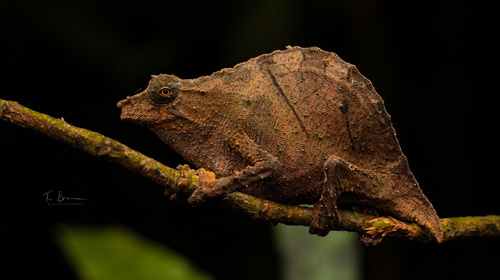
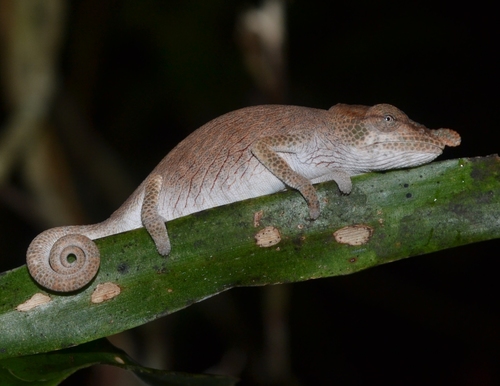
The big-nosed chameleon, with the scientific name Calumma nasutum (Duméril & Bibron, 1836), is one of the smallest arboreal chameleons, and usually reaches a total body length of 11 cm. It gets its common name from the large, paddle-like appendage that sticks out from its nasal area. It is thought that males have a larger, more square-shaped version of this flexible appendage, which is used to identify potential mates. A more prominent casque, or bony head crest, is another trait that distinguishes male big-nosed chameleons. Both sexes usually have brown, reddish-brown, tan, or light green skin. When females are not receptive to mating, they quickly develop a striking pattern of whitish-blue to turquoise spots on the sides of their nasal appendage and the top of their head. Like other chameleon species, the big-nosed chameleon has characteristic features including a prehensile tail, fused toes, turret-like eyes, and an extremely long tongue. This species lives in primary forest, forest edge, and secondary forest habitats, where it occupies low vegetation. It prefers thin trees, shrubs, and bushes, but can also be found on thick lianas in dense rainforest, generally staying 1 to 2 meters above the ground. It is only very rarely found in open terrain, and favors dense foliage and deep rainforest.