About Caltha sagittata Cav.
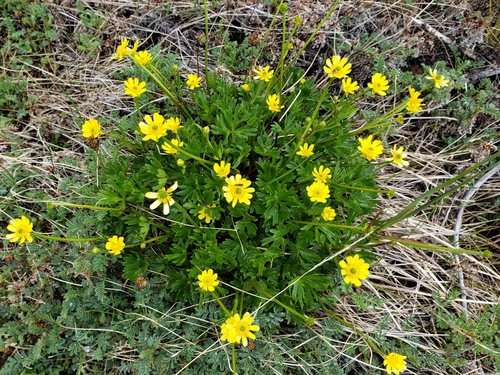
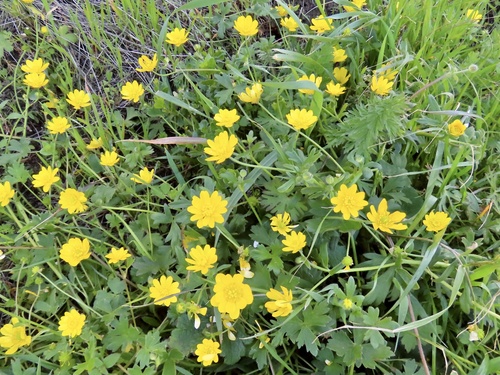
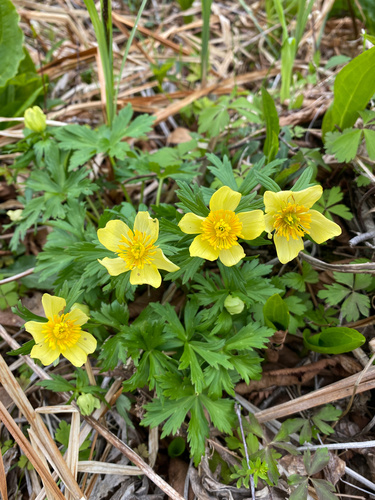
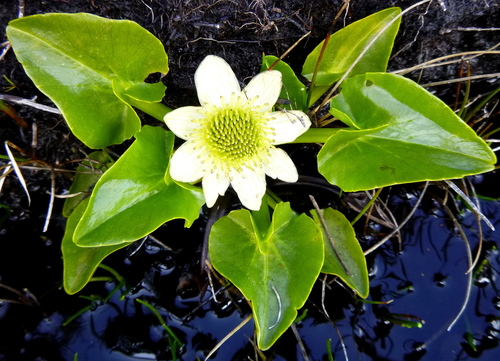
Caltha sagittata Cav. has creeping rhizomes, and can eventually form extensive clusters of plants that may reach up to 30 cm in height, depending on location. Its petioles are 7–30 cm long and up to 7 mm wide. Leaf blades have a broad arrowhead (sagittate) shape with a retuse or blunt tip, and measure between 1 and 4 cm long. Each leaf also has two basal lobes that extend into appendages roughly half as long as the main leaf blade; these appendages are almost fully separate, connected only by a small strip of tissue along the leaf's midrib, and are often positioned approximately at a right angle to the petiole. In some northern forms, which are sometimes considered a separate species called C. alata, these appendages lie in the same plane as the rest of the leaf blade. The solitary, radially symmetric (actinomorphic) flowers are 3 cm or more across, and have five to eight spreading, ivory to pale yellow, petal-like sepals that are ½–1½ cm long and 2–8 mm wide, with a faint honey scent. There are between 30 and 75 stamens, with broad filaments. C. sagittata is a variable species, and it often flowers sparingly. C. sagittata occurs in Argentina (the provinces of Chubut, Jujuy, La Rioja, Mendoza, Neuquen, Rio Negro, Santa Cruz, San Juan, Tierra del Fuego), Bolivia, Chile (the provinces of Coquimbo, O'Higgins, Maule, Bio Bio, Araucania, Los Lagos, Aisen, Magallanes, and Región Metropolitana), Ecuador, the Falkland Islands, and Peru. Its elevational range extends from sea level in Tierra del Fuego to about 4000 m at the banks of Lake Titicaca. It grows in moist open grassland alongside other low herbs, on rill banks, in areas watered by snowmelt trickle, and sometimes in brackish habitats.