About Calotes versicolor (Daudin, 1802)
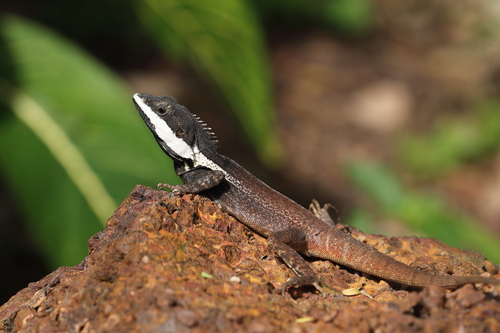
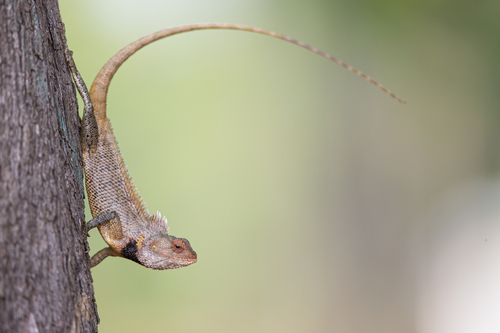
Calotes versicolor is an insectivorous lizard. Breeding-season males develop a bright red throat; during this season (May to early October), a male's head and shoulders also turn bright orange to crimson, with the throat turning black, and males will also turn red-headed after winning a battle against rival males. Both sexes have a crest running from the head nearly to the tail, giving the species another common name: crested tree lizard. This lizard measures over 10 cm (3.9 in) in snout-to-vent length, with a total length including the tail of up to 37 cm (14.5 in); Sri Lankan specimens are generally somewhat larger, with one recorded individual reaching 16 inches in total length, 11 inches of which was tail. Two small, fully separated groups of spines sit above each tympanum. The dorsal crest is moderately elevated on the neck and anterior trunk, extending to the tail root in large individuals, and gradually disappears on the middle of the trunk in younger individuals. There is no fold in front of the shoulder, but the scales behind the lower jaw are much smaller than other scales, and a gular sac is not developed. There are 39 to 43 scale series around the middle of the trunk. In adults, the hind foot (measured from the heel to the tip of the fourth toe) is not much longer than the head, while it is considerably longer in young individuals. Coloration is very variable; it is sometimes uniform brownish, greyish-olive, or yellowish. Broad brown bands generally cross the back, interrupted by a yellowish lateral band. Black streaks radiate from the eye, and some of these streaks continue over the throat, running obliquely backward. The belly frequently has greyish longitudinal stripes, with one along the median line being the most distinct. Young and half-grown specimens have a dark, black-edged band across the inter-orbital region. The base ground color is generally light brownish olive, but this lizard can change its color to bright red, black, or a mixture of the two. This color change is sometimes limited to the head, and at other times spreads across the whole body and tail. Jerdon and Blyth confirm these bright, changeable colors are unique to males during the breeding season. Albert Guenther noted that Alexandre Henri Mouhot collected a fine color variation in Siam, and that the species' color variations appear to be infinite. Calotes versicolor ranges from continental India to China, is very common in Sri Lanka, and does not extend into the temperate zone of the Himalayas. It inhabits hedges and trees. In Sri Lanka it is commonly called "Bloodsucker"; Kelaart suggests this name comes from the occasional reddish hue of its throat and neck. It is also called "Roktochosha" in the Bengali language, which also translates to "bloodsucker". Females lay 5 to 16 soft oval eggs, about 5/8 of an inch long, in tree hollows or burrowed soil holes, then cover the eggs. Young lizards hatch after about 8 or 9 weeks. On hot sunny days, a solitary individual may be seen basking in the sun on a twig or wall with its mouth wide open. After rain showers, many individuals come down to the ground to feed on larvae and small insects that fell from trees during the rain. When escaping danger, changeable lizards dart to the nearest tree. If a predator follows closer, they move to the side of the tree facing away from the predator and swiftly dart up the tree, so the predator only finds the lizard has already reached the upper branches. Unlike some other lizard species, Calotes versicolor does not perform tail autotomy (does not drop its tail). Its tail can be very long, stiff, and pointed. Like other reptiles, it sheds its skin. Like chameleons, changeable lizards can move each eye independently in different directions. The native distribution of Calotes versicolor includes southeastern Iran, Afghanistan, Bangladesh, Bhutan, Cambodia, India (including the Andaman Islands), Indonesia (Sumatra), western Malaysia, the Maldives, Mauritius (Reunion, Rodrigues), Myanmar, Nepal, Pakistan, Philippines, Sri Lanka (Ceylon), Thailand, and Vietnam (including Pulo Condore Island). It has been introduced to Brunei, Celebes, Oman, the Seychelles, Singapore, and the United States. It was introduced to Singapore from Malaysia and Thailand in the 1980s, where it is a threat to the native green-crested lizard. The changeable lizard is relatively common and found in a wide range of habitats. It adapts well to areas dominated by humans, so it is not considered endangered. It is commonly found in undergrowth, open habitats, and highly urban areas. However, people in China regularly kill this lizard, as it is viewed as a pest. During breeding season, males become highly territorial. They deter intruding males by brightening their red heads and performing "push-ups". Males attract females by inflating their throat and drawing attention to their brightly colored head. This species is oviparous. A clutch typically contains 10 to 20 eggs, which are buried in moist soil. The eggs are long, spindle-shaped, and covered with a leathery outer covering. They hatch after about 6 to 7 weeks. Individuals become able to breed at around 1 year old.