About Calotes nigrilabris Peters, 1860
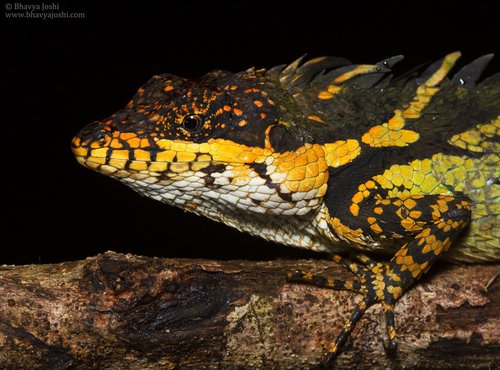
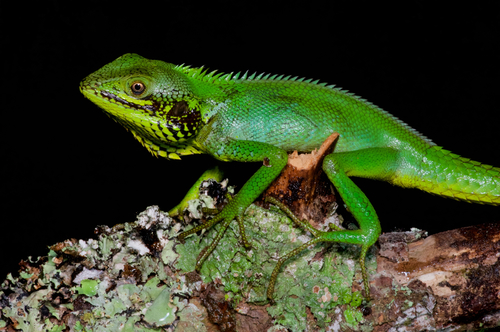
The head of Calotes nigrilabris is one and a half times as long as it is wide. A row of spines runs above and behind the tympanum. Adult males have swollen cheeks, and their gular sacs are not developed. There are 42 to 50 mid-body scale rows, and ventral scales are larger than dorsal scales. The dorsum is green, and can be unpatterned, or marked with cream transverse bars or eye-like spots that have black edges. The head has black markings, and the venter is pale green. This is a submontane and montane species that occurs at elevations of 1,000 m (3,300 ft) and above. It is fairly common at localities including Nuwara Eliya, Pattipola, Ohiya, Horton Plains, and Adam's Peak. This species is largely arboreal, and lives in tree trunks, hedges, and shrubs, where it hunts for insects and worms during the day. In Horton Plains, C. nigrilabris resides on gorse bushes (Ulex europeus) and Rhododendron leaves to hunt insect prey, particularly bees, that are attracted to the plants' flowers. Females lay up to 4 eggs per clutch, which measure 17–23 mm in length and 10–13 mm in width. Newly hatched individuals have a mean snout-vent length (SVL) of 35–50 mm. This species has two separate breeding seasons: one from November to December, and another from February to March. After eggs are laid during these breeding months, hatchlings emerge after approximately two months of incubation.