About Calotes mystaceus Duméril & Bibron, 1837
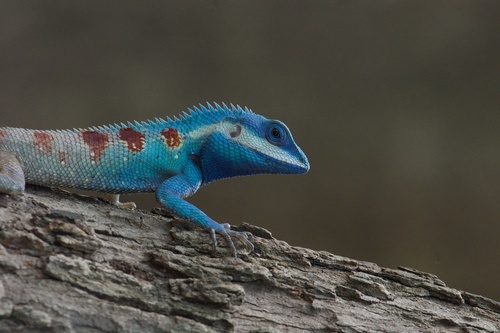
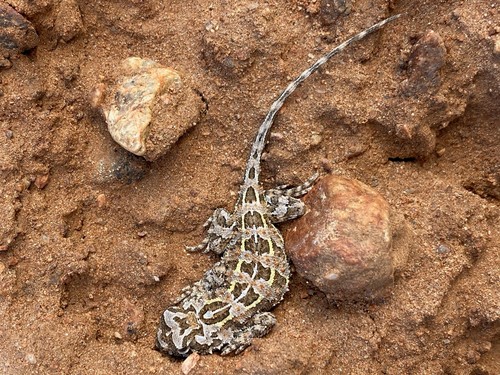
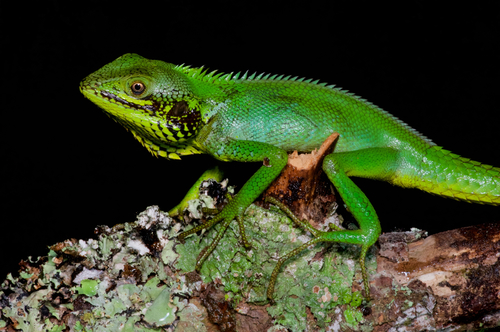
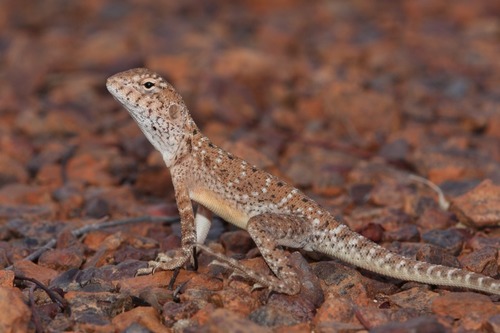
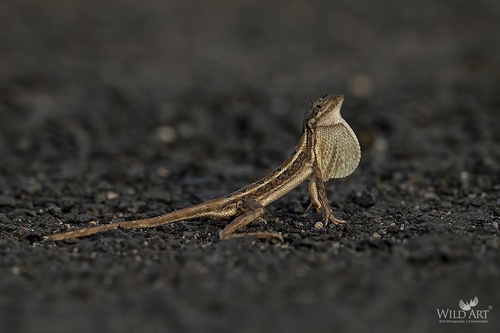
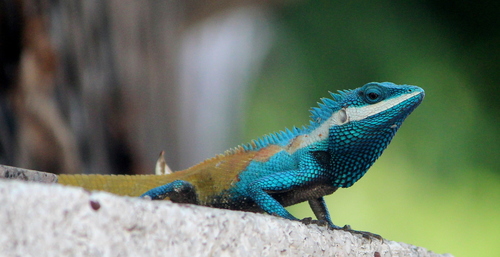
Calotes mystaceus, commonly called the Indochinese bloodsucker or Indo-Chinese forest lizard, has the following physical characteristics. For its head: upper head-scales are either smooth or weakly keeled, overlapping, and scarcely enlarged on the supraorbital region. A few small spines sit on each side of the head above the tympanum; the tympanum measures at least half the diameter of the orbit. The gular sac is small, and gular scales are weakly keeled, matching the size of dorsal scales. There is an oblique fold in front of the shoulder. The dorso-nuchal crest is well developed in males, made of backward-pointing falciform spines; the longest spine is equal to the diameter of the orbit. The crest gradually decreases in height down the back, reducing to a fine denticulation on the sacrum. There are 45 to 53 scales around the middle of the body. Dorsal scales are keeled, almost twice as large as ventral scales, and all point upwards and backwards. Ventral scales are strongly keeled. When pressed against the body, the hind limb reaches either the tympanum or the posterior border of the orbit. The fourth finger is slightly longer than the third. The tail is slightly compressed, with a weakly serrated upper ridge at its base. Its color pattern has a grey to olive background, often marked with large transverse red spots on the back, and yellowish lips. Maximum total length is 42 cm, while common total length is 28 cm, with a snout-to-vent length of 9.5 cm. This species is distributed across Cambodia, Yunnan (China), Mizoram (India), Laos, Myanmar (from Tenasserim to Naypyitaw, covering Naypyitaw, Mandalay, and Kachin State at 26°00N, 97°30E), northern Thailand (Chiang Saen, north of the Isthmus of Kra), and southern Vietnam. It has also been reported from the Chittagong Hill Tracts of Bangladesh, an area adjacent to India's Mizoram state. It is also documented for the first time in Florida, USA, in Okeechobee County and Glades County. It is terrestrial and arboreal, and diurnal. It naturally occurs in forests, but can also be found in treed residential neighborhoods and urban city parks. The Indo-Chinese forest lizard is oviparous. No practical uses are known for this species, and it fills an insectivorous role in its native ecosystems.