About Calotes liolepis Boulenger, 1885
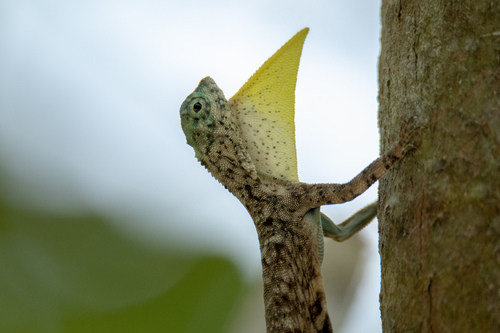
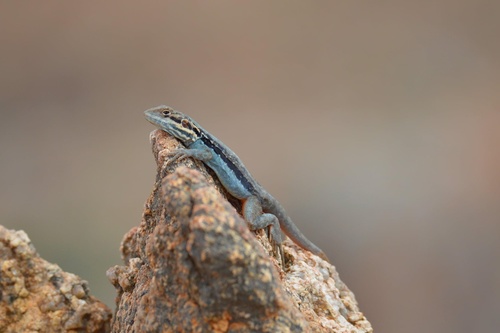
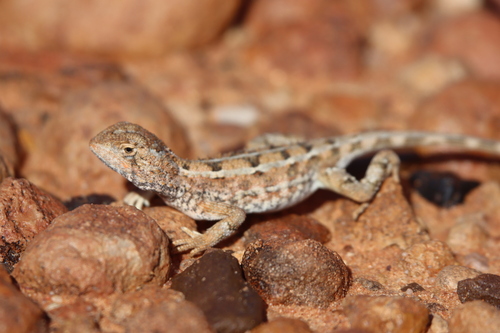
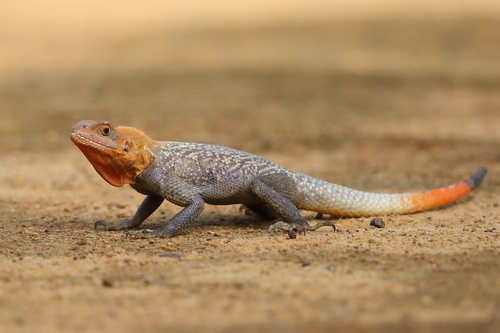
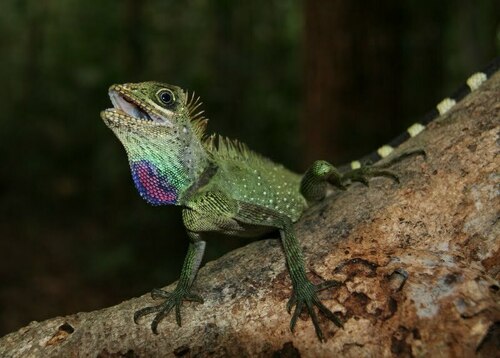
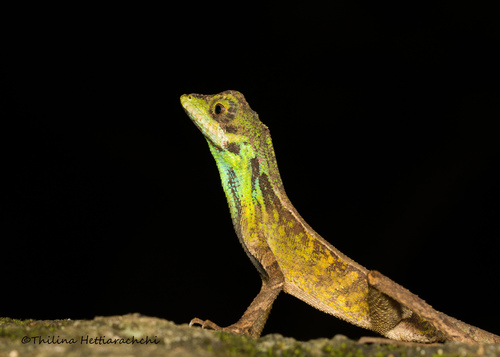
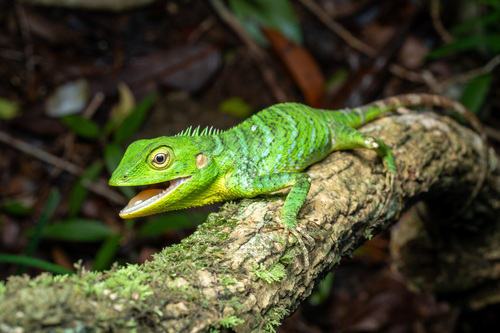
Calotes liolepis, commonly called the whistling lizard, has color-changing camouflage ability, shifting from green to brown to match its surrounding environment. This species has a relatively long head and tail, with the tail typically reaching twice the length of its body. In males, a dorso-nuchal crest is formed by a series of spines on the nape. Both males and females have scales covering the dorsal surface of the body. Ventral scales are the same size as the scales found on the lizard's flanks. The forehead of this species is pale brown, with pale inter-orbital bands. The dorsum is pale gray with dark gray bands, and the limbs and tail have similar dark banding. This species is restricted to submontane forests below 100 meters, and occurs in both forested areas and plantations. While it is widely distributed in its range, it is most frequently found in the central hills of Sri Lanka. Confirmed locations where it has been found include Knuckles, Kotmale, Sinharaja, Talawakele, Hanguranketha, Kanneliya, Galle, Kandy, Dambulla, Peradeniya, Namunukula, and Gampola. Unlike most other agamid lizards, this species has the unusual habit of producing a high-pitched whistle when it is alarmed. It feeds primarily on insects and ants. Gravid females of this species are observed between July and August.