About Calotes calotes (Linnaeus, 1758)
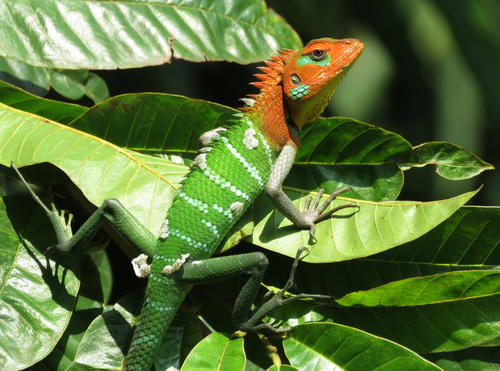
Calotes calotes is a considerably large species of agamid lizard, with a total length of 50 to 65 cm (19.5 to 25.5 inches) including the tail. The length of its head is one and a half times its breadth, and its snout is slightly longer than the orbit. It has a concave forehead, swollen cheeks, and smooth, unequal upper head-scales. Both the canthus rostralis and the supraciliary edge are sharp. Above the tympanum, there is a row of 8 or 9 compressed spines divided into two groups; the diameter of these spines is less than half that of the orbit. Calotes calotes has 9 to 11 upper labials and the same number of lower labials. Its body is compressed, with large dorsal scales that are usually weakly keeled, but sometimes smooth. These scales point backwards and upwards, and are as large as or slightly smaller than the ventrals, which are strongly keeled and mucronate. 30 to 35 scales cover the middle of the body. A gular pouch is not developed, and the gular scales are weakly keeled, and nearly as large as the ventrals. A short oblique fold covered with small granular scales sits in front of the shoulder. The nuchal and dorsal crests are continuous, made up of closely set lanceolate spines with smaller spines at the base. In adult males, the height of the neck crest equals or exceeds the diameter of the orbit, and the crest gradually decreases in size along the back. The limbs are moderate; the third and fourth fingers are nearly equal, while the fourth toe is distinctly longer than the third toe. The hind-limb extends to the front of the eye or further. Calotes calotes has a very long and slender tail. It has bright green dorsal coloration, usually marked with 5 or 6 white, cream, or dark green transverse stripes that can change. These stripes often continue onto the tail. The head is yellowish- or brownish-green, while breeding adult males develop a bright red head and throat. The underside is pale green, and the tail is light brown. Young and immature individuals sometimes have a whitish dorso-lateral stripe. A half-grown specimen cataloged as no. 74.4.29.836 in the British Museum has a broad buff vertebral stripe with elongated dark brown spots. This species roosts on trees with green foliage, such as Azadirachta indica. Very little is currently known about the roosting ecology of this species.