About Calostoma cinnabarinum Desv.
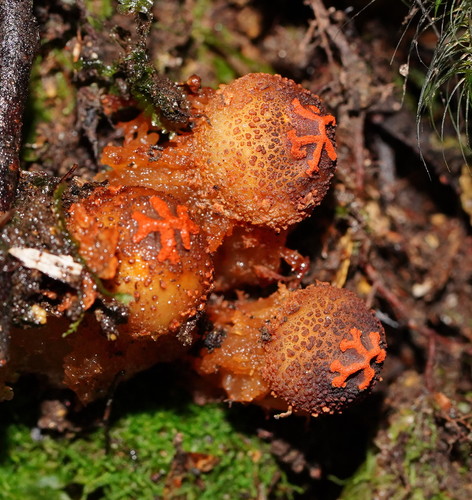
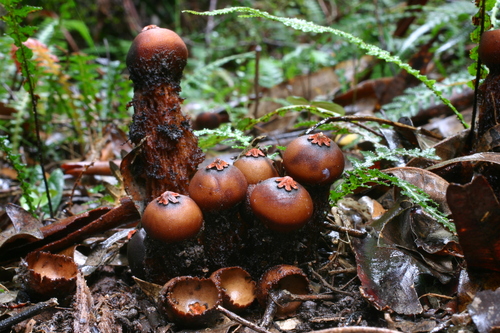
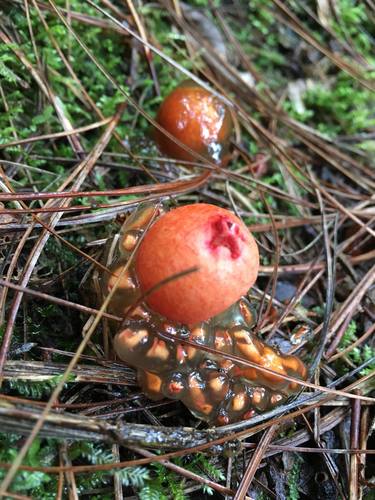
Calostoma cinnabarinum Desv. is a species of gasteroid fungus whose fruit bodies have been compared to amphibian eggs, or small red tomatoes surrounded by jelly. Each fruit body has a bright red, globose head that sits atop a net-like stipe, and the entire structure is covered by a thick gelatinous layer. Fruit bodies begin development underground (hypogeous), and emerge from the ground as the stipe continues to expand. The head can reach up to 2 cm (0.8 in) in diameter, is typically nearly round, though some populations have visibly oval heads that may be slightly smaller or larger. The internal layering of the head is complex; it has been described variously as an exoperidium and an endoperidium, each with their own sublayers, or as a set of distinct separate layers. The outermost layer is a yellowish, translucent jelly-like coating 4 to 9 millimeters (0.2 to 0.4 in) thick, similar in nature to a gelatinous universal veil. Below this coating lies a thin, cinnabar-red membrane. As the mushroom matures, these outer layers break down and fall away from the head. Pieces of the red membrane become embedded in the remaining gelatinous material, giving the mixture the appearance of small red seeds. This breakdown process reveals the endoperidium, a tough, non-gelatinous layer that does not break apart. When first exposed, the endoperidium has a powdery, bright red surface that fades to orange or pale yellow as the powdery coating wears away through weathering. Bright red apical ridges, or rays, form a peristome around the opening. North American specimens usually have four to five of these ridges, while Asian populations have been recorded with up to seven ridges. Contained inside the endoperidium is the gleba, or spore mass, which is white when young and turns buff or yellow in older specimens. Like the head, the stipe is covered by a gelatinous outer layer. The stipe itself is made up of a number of anastomosing gelatinous strands, which give the structure a reticulate (net-like) or spongy appearance. These strands range in color from red to yellow-brown, and fade as the mushroom ages. The stipe is 1 to 2 cm (0.4 to 0.8 in) thick and 1.5 to 4 cm (0.6 to 2 in) long, though some or all of this length may remain buried in the ground.
Calostoma cinnabarinum has a wide distribution. In the United States, it can be found from Massachusetts south to Florida, and its range extends west at least to Texas, with possible populations in the Southwest; it is most common in the Appalachian Mountains, where it becomes more frequent as elevation increases. It is also found in Eastern Mexico, where it grows in the subtropical cloud forests of Veracruz and Hidalgo. In Central America, it is known from Belize's Chiquibul National Park, the cloud forests of Baja Verapaz and El Quiché in Guatemala, and Panama. The species is also recorded in South America, from Colombia southeast as far as Brazil, where it is described as rare. There is a disjunct population in Asia, where it has been recorded from seven provinces in mainland China (mostly in the southeast, including Taiwan), as well as from Indonesia, Japan, and Jirisan in South Korea.
Calostoma cinnabarinum was long thought to be saprotrophic, a classification repeated in both scholarly and popular writing on the species. This classification originated from its early taxonomic history and comparisons to non-closely related saprotrophic fungi. After the species was reassigned to Sclerodermatineae, a suborder whose members are ectomycorrhizal, its ecological role was re-evaluated. In 2007, Andrew Wilson and David Hibbett of Clark University, and Eric Hobbie of the University of New Hampshire, used isotopic labeling, DNA sequencing, and morphological analysis to confirm that C. cinnabarinum is also ectomycorrhizal. Like all mycorrhizal fungi, C. cinnabarinum forms a mutualistic relationship with the roots of host trees: the fungus exchanges minerals and amino acids extracted from soil for fixed carbon produced by the host. The fungus's subterranean hyphae grow a tissue sheath around the tree's rootlets. This association is particularly beneficial for the host tree, because the fungus produces enzymes that mineralize organic compounds and facilitate the transfer of nutrients to the tree. The only confirmed host trees for C. cinnabarinum are oaks in the genus Quercus, though related Calostoma species have been observed associating with other Fagaceae trees such as beech.
In addition to its required association with oaks, C. cinnabarinum appears restricted to wetter forests. Early habitat descriptions noted it occurs in rather moist situations and damp woods, and more recently David Arora documented its preference for the humid forests of the southern Appalachians. It has not been detected in California's dry oak forests, and is likely absent from the dry tropical forests of western Costa Rica. In Brazil, it has been observed growing in sandy soil and drier conditions of the Caatinga and cerrado, though only after periods of heavy rainfall. Its thick outer gelatinous layer may provide protection from desiccation. Fruit bodies appear most commonly in late summer and fall, though they have also been recorded in spring. Squirrels are known to feed on C. cinnabarinum, while the species' gelatinous coating deters insect predation.
Field guides generally consider C. cinnabarinum inedible, like all species in its genus. Because fruit bodies begin development underground, they are already too tough for consumption by the time they emerge above ground, and their appearance is often considered unappetizing. A study of cultural practices among mestizo descendants of the Otomi people in Tenango de Doria, Mexico, recorded that immature C. cinnabarinum specimens, known locally as yemitas, were frequently eaten raw in the past, especially by children. This practice was no longer common at the time of study, with only five out of 450 interviewed locals familiar with the custom. The gleba of C. cinnabarinum has been described as having a mild taste, and contrary to local recollections, it is not sweet. The species has also been used in traditional medicine. A 1986 ethnomycological study of native traditions in Veracruz documented this use for the mushroom, called huang noono locally: locals roast it, then grind it into a powder consumed with mineral water to treat gastrointestinal distress. In contrast to these Mexican traditions, folk beliefs in Hunan hold that the mushroom is poisonous because of its bright color.