About Calopteryx dimidiata Burmeister, 1839
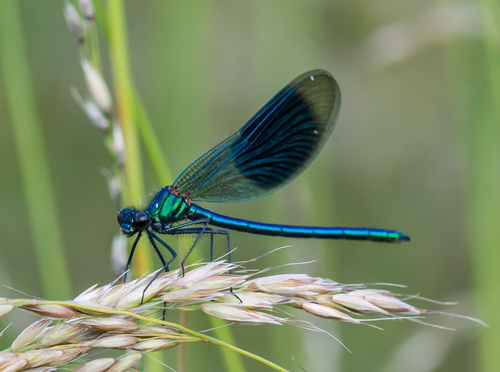
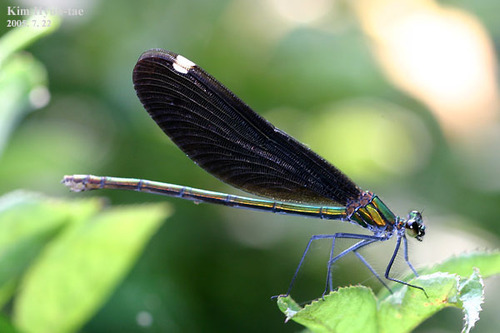
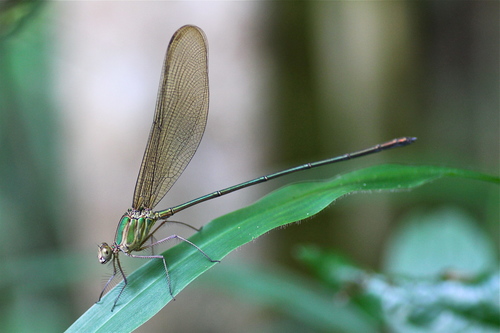
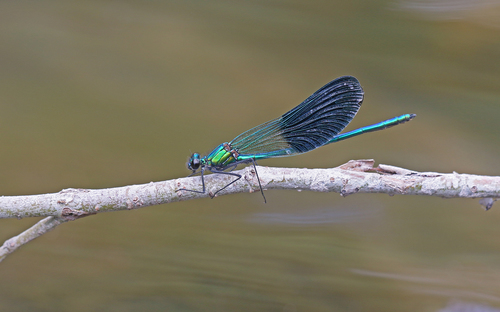
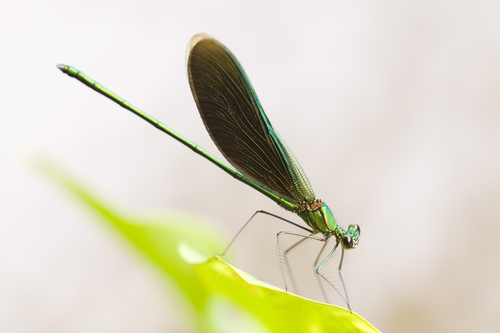
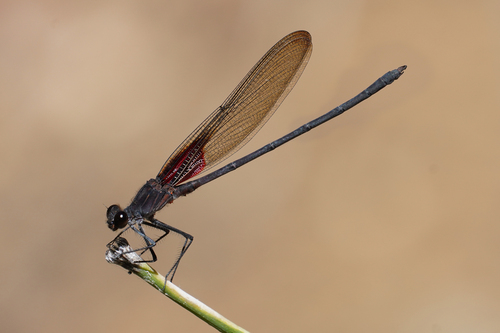
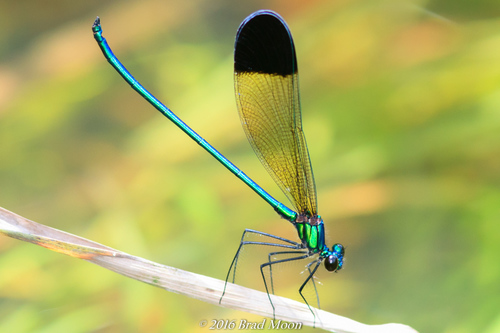
Commonly called the sparkling jewelwing, Calopteryx dimidiata Burmeister, 1839 is one of the smallest damselflies in its family, with a total length of 37 to 50 millimetres (1.5 to 2.0 in). Its thorax and long slender abdomen are metallic bluish-green, and its eyes are brown. In males, the end fifth of each wing is black, with a straight line separating this dark section from the remaining transparent hyaline wing tissue. Females are a slightly more bronzy-green. Their wings may match the male's pattern but with less clear markings, only the hindwings may have black tips, or all wings may be entirely clear. There is usually a small white pterostigma near the wing tip. Immature adult sparkling jewelwings have reddish eyes and generally duller colouring. For males of this species, forewings and hindwings differ in size by no more than 2 millimetres (0.08 in), both wing pairs have a straight-edged black wing apex band that ends distal to the nodus, and the sternum of the tenth abdominal segment is black. These features distinguish this species from other members of its genus that share its geographic range. Sparkling jewelwings are distributed across the eastern and southeastern United States. Their range extends from New England to Louisiana and parts of Texas, and occurs mainly on the Atlantic coastal plain. Their typical habitat is sandy, fast-flowing, often acidic forest streams with abundant riverside vegetation. The flight season of the sparkling jewelwing runs from May to September in New Jersey, and from February to November in Florida. Both males and females are often found together near breeding sites: males patrol small territories, circling and chasing off rival males. When a female is present, ritualised courtship flights occur before copulation, which lasts approximately two minutes. After mating, the female walks down the stem of an emergent plant and spends around fifteen minutes underwater, where she lays a batch of several hundred eggs before returning to the surface.