About Calonectris diomedea borealis (Cory, 1881)
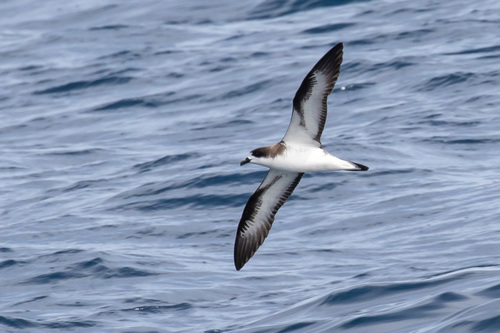
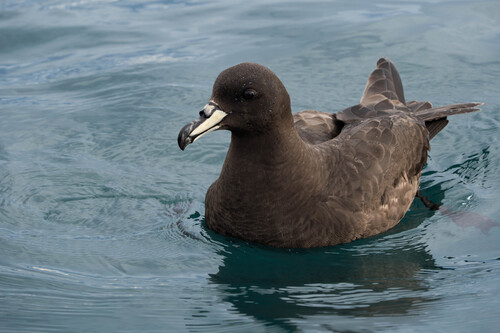
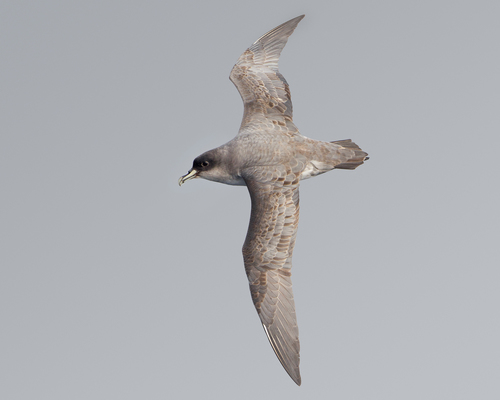
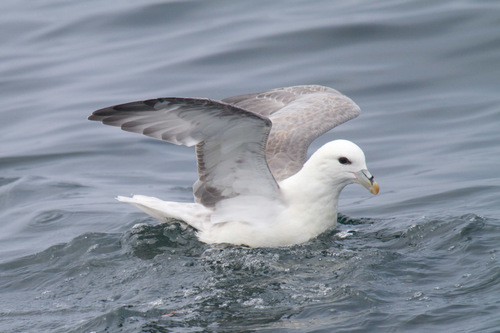
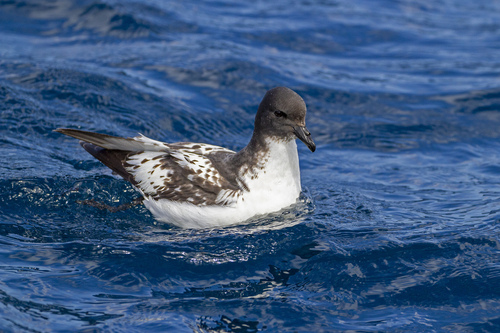
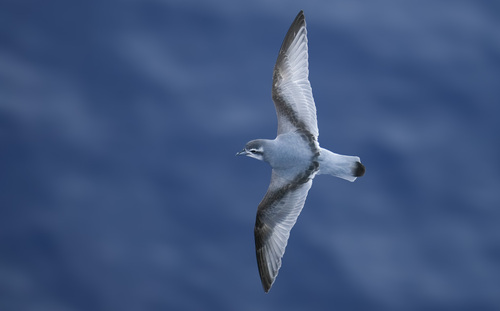
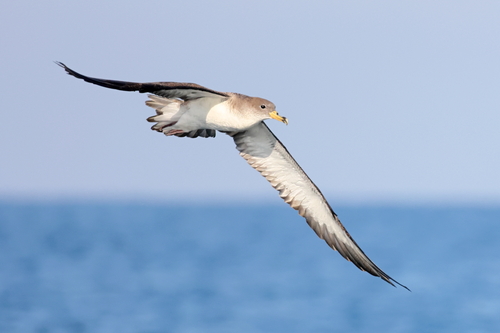
Scopoli's shearwater has an overall length of 45–52 cm (18–20 in) and a wingspan of 112–122 cm (44–48 in). Its upperparts are brownish-grey, with most feathers fringed in lighter brown, and its wings are darker brown. The upper tail-coverts have whitish tips, and the tail itself is dark brown. Most of its underparts are white, with a brown border that is most prominent along the trailing edge of the wing. Its bill is pale yellow with a dark patch near the tip, and its legs and feet are pale flesh-coloured. The sexes have similar appearance, though males are on average slightly larger than females. Scopoli's shearwater looks very similar to Cory's shearwater, and the two species can be hard to tell apart. Compared to Cory's shearwater, Scopoli's shearwater has more white on the primary feathers at the wingtip, especially on the outermost large feather (P10). The Cape Verde shearwater is smaller than Scopoli's shearwater and is significantly darker on its upperparts. Scopoli's shearwater breeds on islands in the Mediterranean, ranging from the Chafarinas Islands off the Moroccan coast in the west to the Greek Dodecanese islands in the east. The largest colony is located on the rocky island of Zembra, 13 km (8.1 mi) off the Tunisian coast. This colony holds between 141,000 and 223,000 breeding pairs, which makes up more than 75 percent of the global population of the species. Other large colonies are found on Linosa in the Strait of Sicily, and on the Balearic Islands. At the end of October, after the breeding season finishes, Scopoli's shearwaters migrate to the Atlantic, leaving the Mediterranean through the Strait of Gibraltar. They return to the Mediterranean at the end of February. Studies using light-level geolocators found that birds tagged on Linosa or the Pantaleu islet in the Balearic Islands spent the winter in regions associated with major upwellings in the southeast Atlantic. The birds either foraged off the coast of West Africa in the upwelling linked to the Canary Current, or traveled further south to forage in the Benguela Current off the coast of Namibia. Scopoli's shearwater feeds mainly on small fish, and also eats cephalopods and crustaceans. It feeds by skimming over the water surface or by surface feeding, and only rarely plunges completely beneath the surface. It sometimes follows whales and tuna to pick up food scraps and catch small fish that have been driven to the surface. It will also scavenge discards from fishing vessels.