About Calochortus umpquaensis Fredricks
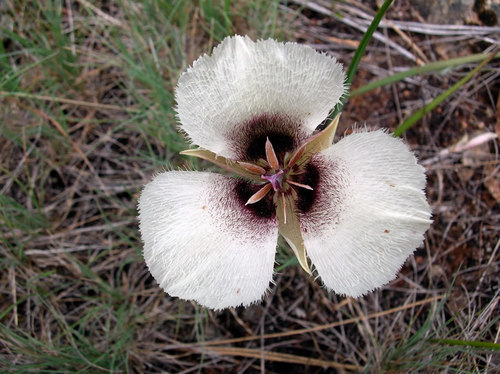
Calochortus umpquaensis is a species of flowering plant in the lily family, commonly known as Umpqua mariposa lily. It is endemic to Oregon in the United States, where it is mostly restricted to the Klamath Mountains region around the Little River in Douglas County, especially the Watson and Ace Williams Mountains. Individual populations have also been discovered at one location each in Josephine County and Jackson County. This plant was formally described to science in 1989, when an isolated population previously classified as Calochortus howellii was determined to belong to a distinct separate species. Its stem grows between 20 and 30 centimeters tall, and the inflorescence holds one or more flowers. The bell-shaped bloom has three hairy white or cream-colored petals, each up to 3.5 centimeters long, with a bearded purple-black blotch at the base. The fruit is a capsule that can reach up to 5.4 centimeters in length. This wildflower always grows on serpentine soils across multiple habitat types, including coniferous forest, grassland, and the ecotones between these two environments. The serpentine soils it inhabits are high in nickel, cadmium, magnesium, and phosphorus. Plant species that commonly grow alongside it include Jeffrey pine (Pinus jeffreyi), incense cedar (Calocedrus decurrens), Douglas-fir (Pseudotsuga menziesii), Hooker's silene (Silene hookeri ssp. hookeri), showy tarweed (Madia elegans var. densifolia), cismontane minuartia (Minuartia cismontana), and Roemer's fescue (Festuca roemeri). While it is rare overall, this species can be locally abundant: the population on Ace Williams Mountain numbers between 400,000 and 800,000 individuals. Threats to the species include nickel mining, invasive introduced plant species, and poaching. Logging and cattle grazing are also threats, but these impacts have recently been mitigated on federally managed lands.