About Calochortus striatus Parish
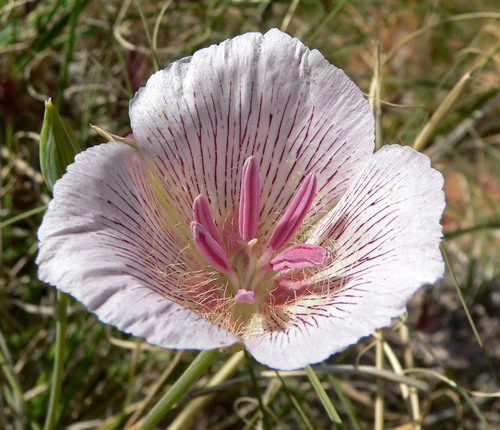
Calochortus striatus produces an erect stem that is usually only a few centimeters tall, though it can sometimes grow significantly taller. It also has a long basal leaf that may lie flat on the ground. The stem may branch at least halfway up its length, and each branch is topped by a bell-shaped lily-like flower. Pointed sepals form the base of the flower; above these are three rounded petals 2 to 3 centimeters long that may have slight tooth-like edges. Petal color ranges from very light to very dark pink, lilac, or purplish, with darker pink or purple veining or mottling. The inner cup of the flower is somewhat hairy. The anthers are bright to dull pink, and produce pink pollen. Bulb-grown plants bloom from April to June. The fruit is a capsule up to 5 centimeters long that produces flat seeds. This species is primarily native to the Mojave Desert, including its Antelope Valley region. It also has existing populations in the Kern River Valley, adjacent southern Sierra Nevada, Amargosa Desert, Owens Valley, Yosemite Valley, and eastern Transverse Ranges. It grows in alkaline soils, most commonly in wetland-riparian areas within Shadscale scrub and chaparral habitats.