About Calochortus raichei Farwig & V.Girard
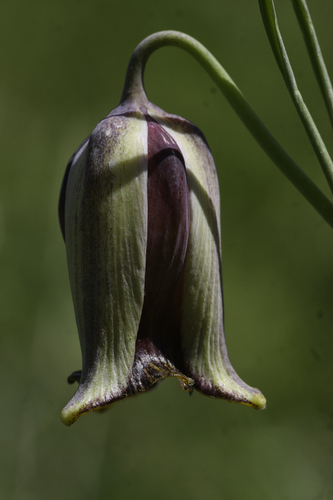
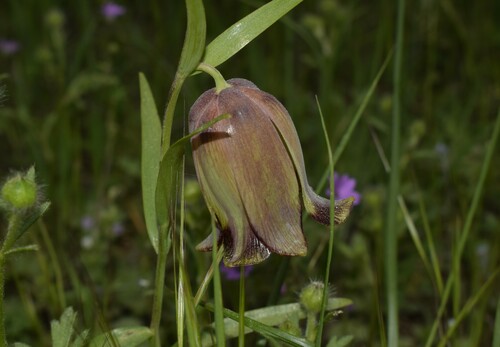
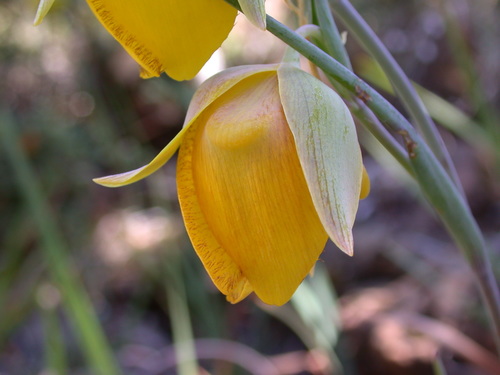
Calochortus raichei is a perennial herb that grows from a bulb covered in a membranous coating. It typically produces a stem 2 to 5 decimeters tall, though the stem can reach 1 meter tall in some years. Its single gray basal leaf grows up to 40 centimeters long, and it is usually withered by the time the plant flowers. Smaller leaves may grow higher up the stem. The above-ground plant tissue generally has a very waxy texture. The inflorescence usually bears only one or two nodding flowers, because side branches do not usually develop. In favorable growing sites, side branches may produce 3 to 12 additional flowers. The flowers are spherical in shape, with their petal tips touching. The plant has three sepals around 2 centimeters long that are dull tan to greenish, and three petals around 4 centimeters long that are yellow. Both sepals and petals turn orange-bronze as they age. The inner surface of the petals is coated in hairs and fringed along its edges. The fruit is an angled capsule about 3 to 5 centimeters long, which holds dark brown seeds. This species is restricted to ultramafic rock formations with serpentine soil at the headwaters of Big Austin and East Austin Creeks, which belong to the Russian River watershed. In the East Austin headwaters, it is not limited to The Cedars, but extends southeast in a contiguous band of ultramafic rock that crosses parts of Murray, Devil, Thompson, Morrison and Gilliam Creeks, where it grows on flanking slopes. It also grows in Grasshopper, Danfield, Cedar and House Creeks, which are part of the Wheatfield Fork of the Gualala River watershed.