About Calochortus amabilis Purdy
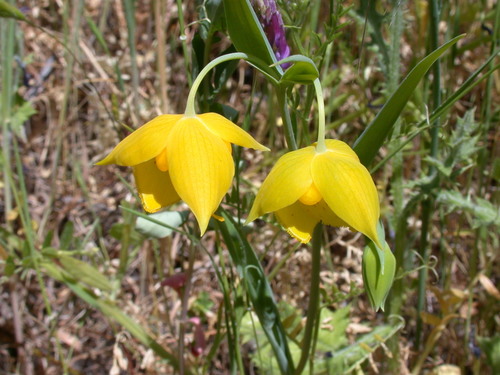
Calochortus amabilis Purdy is a bulbous perennial herb. It grows an upright, somewhat waxy branching stem that reaches 10 to 50 centimeters in height. At maturity, it reaches 10 to 50 centimeters (4–20 inches) tall, with a spread of 5 centimeters (2 inches). Stems are glaucous, stout, flexuous, and generally branching. It produces two types of leaves: basal (radical) and cauline. The basal leaf is flat, waxy, narrow, and lanceolate-acuminate with a shiny surface; it can grow up to 50 centimeters long, and does not wither away during flowering, remaining persistent through bloom and early fruiting. There are 2 to 4 cauline leaves, which are lanceolate to linear and measure 2 to 20 centimeters in length. The inflorescence holds two or more heavily nodding pendent flowers arranged in open branched clusters. Lanceolate bracts on the inflorescence measure 2 to 10 centimeters long. Individual flowers measure 2.5 to 4 centimeters long, and bloom from April to June. The perianth is shaped like a sphere, with tips either neatly closed or slightly overlapping. There are three conspicuous spreading sepals that are ovate to lanceolate, deeply appressed at the base to the petals, often tinged green or red, 1.5 to 2 centimeters long, and held horizontally to slightly descending. There are three ovate or widely lanceolate yellow petals, slightly longer than the sepals at 1.6 to 2 centimeters long, with a short claw and obtuse apex, deep to bright yellow in color, sometimes tinged green with abaxial brown spots. Petals are glabrous except for their margins, which are densely ciliate, fringed with small hairs. The inside of the petals is waxy and coated in small hairs. The nectary is crescent-shaped to almost rectangular, depressed, forming a knoblike structure on the outside of each petal, with several transverse fringed membranes bearing white or yellow glandular hairs, covering 1/3 to 2/3 of the petal width. The filaments of the stamens are 5 millimeters long and dilated at the base; anthers measure 3 to 4 millimeters long and are white to pale yellow. The fruit is a nodding, oblong, winged capsule up to 3 centimeters long, holding dark brown, irregularly shaped seeds. This species is endemic to northern California, occurring from the East Bay (notably Mount Diablo State Park) north of the San Francisco Bay Area. It grows in the Northern California Coast Ranges and Klamath Mountains, at altitudes between 100 metres (330 ft) and 1,500 metres (4,900 ft). It is a common part of scrub and woodland flora, found growing on dry slopes in California oak woodland and chaparral habitats. It can grow in a wide range of soil types, from nearly solid serpentine rock to yellow clay. Its natural habitat receives at least 75 cm of rain per year, followed by a dry, hot summer; winters are cool but not frigid, corresponding to USDA zones 8-9. Its growing season runs from midwinter through April–June flowering and seed set, and the plant goes dormant from mid-June to November. Common understory plant associates include Calochortus luteus, Clarkia unguiculata, and Delphinium variegatum. The bulbs of this plant are a traditional food of the Kashaya Pomo of California. The Kashaya Pomo bake or boil the bulbs, then eat them like baked or boiled potatoes. They are a beloved food for the Pomo, who refer to them locally as "bo". Calochortus amabilis is cultivated as an ornamental plant by specialty native plant and bulb nurseries, for use in traditional gardens, wildlife gardens, and natural landscaping projects. It is hardy, particularly if well mulched. In cold regions, it can be grown in an alpine house or unheated glasshouse. It prefers sun, partial shade, or full shade. It is adaptable to different soils but prefers well-drained, humus-rich, water-retentive growing medium made of up to two thirds organic matter and one third sand, gravel, or grit. It has moderate drought tolerance. In the wild, it receives more than 2.5 cm of rain per week during the growing season. Potted plants need 2.2 to 3.8 cm of water per week, as containers dry out more quickly than ground soil. The plant requires complete dryness during its dormant season; some growers dig up bulbs over summer to prevent premature autumn growth or bulb rot. To propagate, sow seed as soon as it is ripe; seeds do not require any special treatment to germinate. The species has no notable common pests or diseases. In the wild, Calochortus amabilis naturally hybridizes with Calochortus tolmiei.