About Calochortus albus (Benth.) Douglas ex Benth.
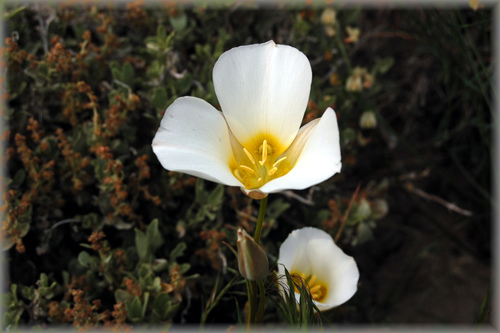
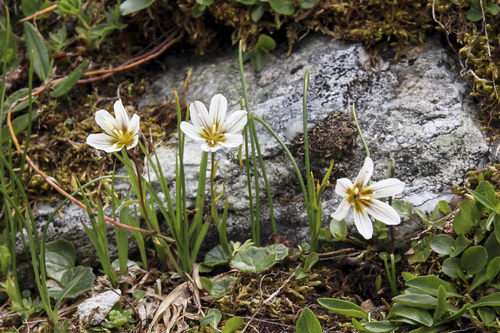
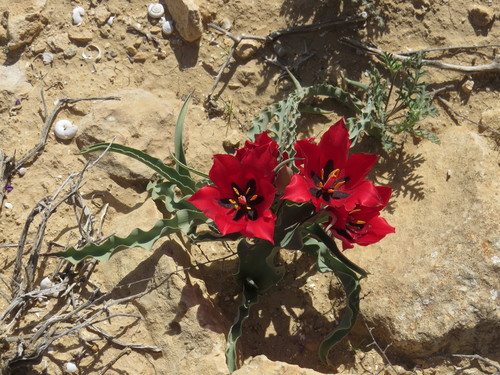
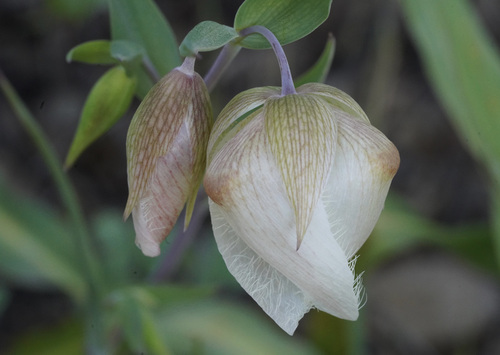
Calochortus albus (Benth.) Douglas ex Benth. is a widespread and variable species that blooms during winter and spring, then goes dormant after flowering until autumn rains begin. At maturity, the plant reaches a height of 20 to 80 cm; its stems, which reach 7.5 to 80 cm, are erect to arching, slender, glaucous, and can be simple or branching. It produces two types of leaves: basal (radical) and cauline. One long basal leaf is present during bloom, alongside several cauline leaves and leaf-like bracts below the flowers. Basal leaves measure 20–70 cm long by 1–5 cm wide, and are lax, shiny, and persistent. There are 2–6 lanceolate to linear cauline leaves, which measure 5–25 cm in length. Inflorescences hold 1, 2, or many flowers. Bracts are generally paired, lanceolate, and 1–5 cm long. Flowers are delicate, pendent, nodding, closed 2–3 cm orbs that are most often pearly white, but can also range to pink, deep pink, almost wine-red, and occasionally greenish. Flowering occurs from late March through early July. While C. albus flowers may occasionally have a pink flush, deeper rose-colored plants found from the southwest San Francisco Bay to the outer south coast ranges may be classified as C. albus var. rubellus if this taxon is recognized. The perianth is oblong and typically closed at the tip. There are three ovate to lanceolate sepals 1–1.5 cm long, appressed to the petals and only rarely recurved. Sepals may be white, green, greenish-white, or rosy red, and are shorter than the petals. There are three elliptic or wider petals that are satiny, 2–2.5 cm long, slightly overlapping, and closed at the tip. The inside of the petals is sparsely ciliate, with yellowish slender hairs above the nectary or along the gland. The outside of the petals may have a green, copper, pink, lavender, or purple tinge, typically near the petal base and around the protruding glandular area. The nectary is crescent-shaped, shallowly to deeply depressed, and has several transverse fringed membranes with white or yellow glandular hairs that span 1/3 to 2/3 of the petal width. Stamens are short, oblong, abruptly tipped, white to light pink, and measure 4 mm long. Filaments are 4–5 mm long and dilated at the base. Anthers are white to cream, oblong and obtuse, and measure 4 mm long. The fruit is a nodding, elliptic-oblong, prominently 3-winged capsule that measures 2–4 cm in length. Seeds are dark brown and irregularly shaped. This species grows widely in shady to open woods and scrub, partially shaded grasslands, and exposed coastal bluffs, and is often found in rocky areas. It occurs in many plant communities below 5,000 ft (2,000m), including foothill woodlands, yellow pine forests, and chaparral. It is present throughout the southern two-thirds of California, found in the Sierra Nevada foothills, southern coast ranges, and peninsular ranges, ranging from Baja California through San Diego to the San Francisco Bay Area, and extending into northern California and to the California Channel Islands. In cultivation, this species prefers full sun to partial shade. It is adaptable to different soils but favors well-drained soil. It is drought tolerant to moderately drought tolerant. In the wild, it receives little to no rain during its natural dormant period. For cultivation, provide regular water throughout the growing season, then allow the bulbs to dry once leaves begin to yellow. Bulb loss is most often caused by premature autumn growth and poor drainage. It is hardy to -18 °C, and possibly hardy to temperatures as low as -23 °C, corresponding to USDA hardiness zones 9-10.