About Calochilus campestris R.Br.
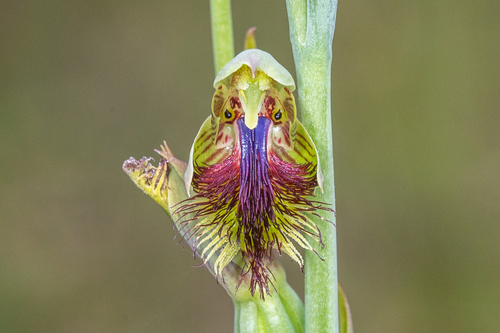
Calochilus campestris is a terrestrial, perennial, deciduous herb that grows from an underground tuber. It produces a single fleshy, channelled leaf that measures 150–350 mm (6–10 in) long, 10–15 mm (0.4–0.6 in) wide, and is triangular in cross section. Between three and fifteen pale green flowers with reddish lines are borne on a 300–600 mm (10–20 in) tall flowering stem; each flower is 18–22 mm (0.7–0.9 in) long and 12–16 mm (0.5–0.6 in) wide. The dorsal sepal is erect and egg-shaped, 9–12 mm (0.4–0.5 in) long and 6–7 mm (0.24–0.28 in) wide. The lateral sepals are a similar length to the dorsal sepal but narrower. The petals are lance-shaped to egg-shaped, 6–8 mm (0.2–0.3 in) long and 3–4 mm (0.1–0.2 in) wide, and spread widely apart from each other. The labellum is egg-shaped and curved when viewed from the side, 14–16 mm (0.55–0.63 in) long and 5–6 mm (0.20–0.24 in) wide. The base of the labellum is fleshy and bears two smooth, metallic blue plates, while the middle part has bristly purple hairs. The tip of the labellum has a short glandular "tail" 4–5 mm (0.16–0.20 in) long. The column has two false "eyes" with no ridge joining them. Flowering occurs from October to November, and each individual flower only lasts between two and four days. Common name copper beard orchid, this species grows in a wide range of habitats from heath to montane forest. It occurs south from the Blackdown Tableland in Queensland, across coastal New South Wales and as far inland as Temora, and is widespread throughout Victoria. In Tasmania, it is only known from a single collection made on Clarke Island in 1979. In South Australia, it is only known from a single record from Mount Billy Conservation Park on the Fleurieu Peninsula in 1983.