About Calocephalus lacteus Less.
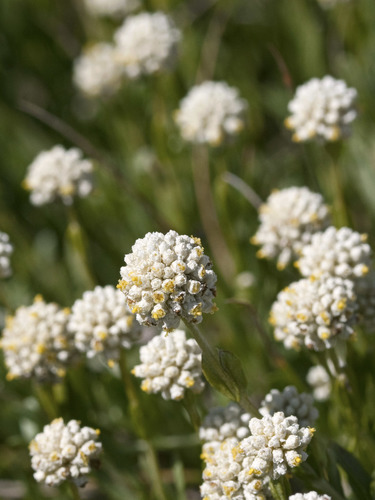
Calocephalus lacteus Less. is a perennial ascending spreading herb that grows via rhizomes. It reaches 5 to 70 cm in height and forms dense groundcover. Its grey-green leaves are arranged oppositely on the lower portion of the stem, and alternately toward the stem apex. Leaves take an obovate to lance shape, or are almost linear, measuring 1–5 cm long and 1–4.5 mm wide, covered in short matted hairs. A prominent midrib and two lateral veins are usually visible on leaves. The plant's globular compound flower heads are dense clusters of 20 to 200 capitula each, with the entire compound head measuring 0.6–1.5 cm long. Each capitulum holds 2 to 3 yellow florets, enclosed by 9 to 16 white bracts that are flat to folded, measuring 1.5–3.3 mm long. The fruit produced is a cypsela, which has 6 to 11 bristles and fine hairs on its upper portion. Flowering occurs most often from November to March. This species, commonly known as milky beauty-heads, grows in low-lying, occasionally wet, grassy habitats in New South Wales, Victoria, Tasmania, and South Australia.