About Caloboletus radicans (Pers.) Vizzini
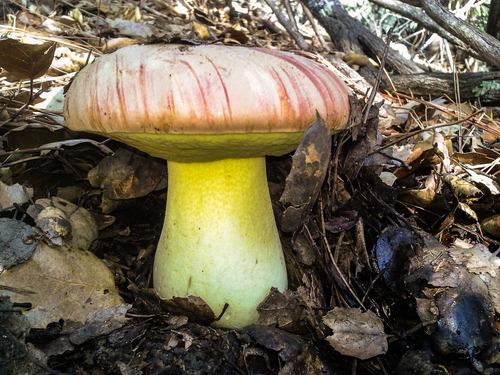
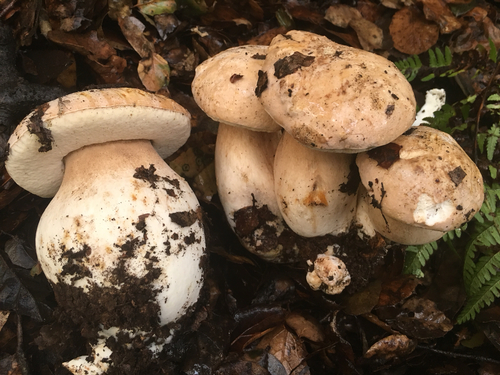
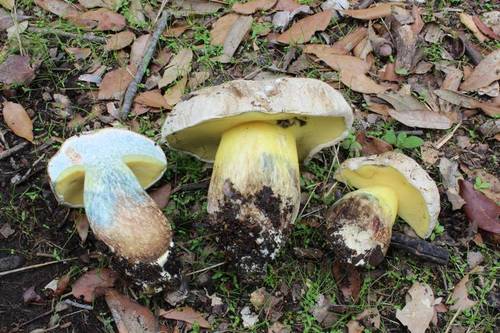
Caloboletus radicans (Pers.) Vizzini has a cap with a diameter of 7.5 to 30 cm (3.0 to 11.8 inches) across. The cap is typically dirty white, greyish-white, ivory white, or buff; it starts with a downy texture, and often develops fine cracking at the center as it expands. The stipe measures 5–8 cm (2.0–3.1 in) tall by 3–4 cm (1.2–1.6 in) wide. It is usually swollen or barrel-shaped when young, then becomes elongated and roughly fusiform, with a tapering base that usually roots into the growing substrate. The stipe apex is characteristically bright lemon yellow, and the color fades toward the lower portion of the stipe. A light straw-coloured reticulation is present on the upper stipe, and this feature may be indistinct in rare cases. The flesh is pale yellow; it is paler, ranging from whitish to straw-coloured, within the cap, and turns dark blue immediately when cut. The pores are lemon yellow, small, and rounded, and turn blue when bruised by touching or injury. The spore print of this species is olivaceous walnut-brown. Under microscopic examination, spores are ellipsoid to fusiform, measuring 11.5–14 × 4–5.5 μm. The cap's hyphal structure is a trichodermium made of interwoven septate hyphae, which are often finely incrusted. This fungus fruits during warm spells in summer and early autumn. It is ecologically versatile, and forms ectomycorrhizal associations with a wide variety of broad-leaved trees, including oaks (Quercus), beech (Fagus), hornbeam (Carpinus), chestnut (Castanea), and lime (Tilia). It grows on both calcareous (chalk) and acidic soils. It is common in southern England, and occurs across much of Europe.