About Callyspongia aculeata (Linnaeus, 1759)
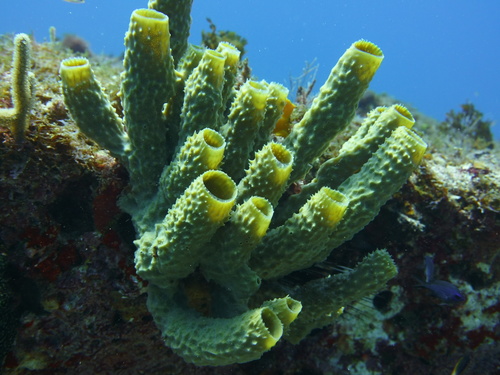
This species is the sponge Callyspongia aculeata. As a sponge (phylum Porifera, class Demospongiae), it is a suspension feeder that filters plankton and other microorganisms through its osculum. All poriferans contain three main cell types: choanocytes, pinacocytes, and archeocytes. Most poriferans have choanocytes made up of a single flagellum surrounded by microvilli, a structure that enables water entry. Within Demospongiae, the organization of choanocyte chambers differs from that of other poriferan groups. Demosponge skeletons are primarily formed from spongin, which is the main component of most demosponge skeletons. While sponges lack defined organ systems, their body tissue is made up of pinacocytes and choanocytes, two cell types found on the sponge surface. In terms of ecological morphology, large branching erect sponges are prone to toppling during storms, while smaller sponges retain higher biomass after storm events. Sponges that survived hurricanes were found to have different silica content in their fiber skeletons. Sponges with larger openings and smaller bases are less prone to breakage and survive more easily in shallow water than sponges with thin, narrow branches. All sponges are hermaphroditic. Demospongiae species can reproduce either by developing sexually produced larvae, or through asexual fragmentation. Asexual fragmentation occurs when an individual splits into smaller segments. Sponges often have more successful asexual reproduction because they do not need to produce sexually generated larvae, and they can spread over larger areas more quickly, which increases their dispersion rate. Sponges can use fragmentation as a survival strategy in disturbed environmental conditions. Although Callyspongia aculeata itself has not been studied in depth, another species in the same genus, Callyspongia diffusa, has a spicular skeleton encased in spongin. Callyspongia aculeata is distributed in the Caribbean, Florida, Bermuda, and the Bahamas. It grows in water temperatures between 20° and 24 °C.