About Calloselasma rhodostoma (Kuhl, 1824)
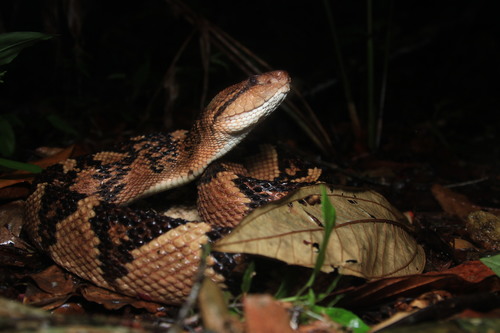
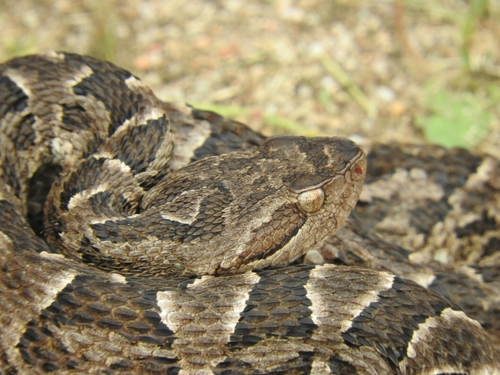
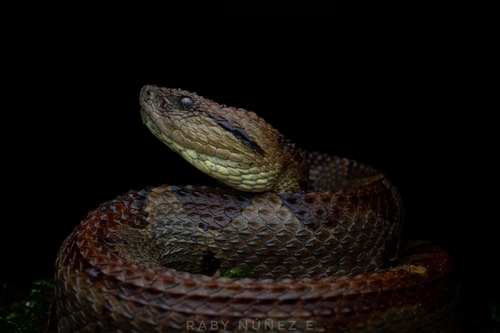
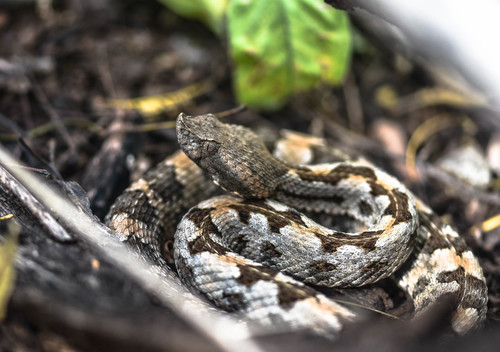
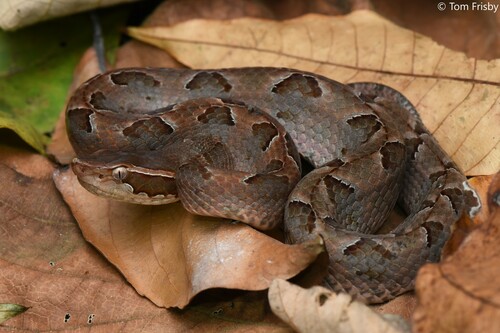
This species, Calloselasma rhodostoma, reaches an average total length of 76 cm (30 in), with females growing slightly longer than males. Occasional individuals can grow up to 91 cm (36 in) in total length. For a specimen measuring 81 cm (32 in) in total length, the tail is 9 cm (3.5 in) long. Dorsally, the body is colored reddish, grayish, or pale brown, marked with two series of large, dark brown, black-edged triangular blotches that are either alternating or opposite each other. A thin dark brown vertebral stripe is also present, and this stripe may be interrupted or indistinct in some specimens. The upper labials are pink or yellowish, and speckled with brown. A broad, dark brown, black-edged diagonal stripe runs from the eye to the corner of the mouth, with a narrower light-colored stripe positioned above this dark stripe. Ventrally, the body is yellowish, and can be uniformly colored, speckled, or spotted with grayish brown. The smooth dorsal scales are arranged in 21 rows at midbody. There are 138 to 157 ventrals, the anal plate is entire, and there are 34 to 54 pairs of subcaudals. The snout is pointed and upturned. The rostral scale is as deep as it is broad. There are two internasals and two prefrontals. The frontal scale is as long as, or slightly longer than, its distance from the tip of the snout, and as long as, or slightly shorter than, the parietals. There are 7 to 9 upper labials, and the loreal pit does not contact the upper labials. This is the only Asian pit viper that has large crown scales and smooth dorsal scales. Its confirmed geographic range includes Nepal, Thailand, Cambodia, Laos, Vietnam, northern West Malaysia, and the Indonesian island of Java. The listed type locality for the species is "Java". Unconfirmed but credible reports exist of this species from southern Myanmar (Burma), northern Sumatra, and northern Borneo. It prefers habitats including coastal forests, bamboo thickets, unused overgrown farmland, orchards, plantations, and forests surrounding plantations, where it hunts rats and mice for food. This species is oviparous, and females guard the eggs after they are laid.