About Callorhinus ursinus (Linnaeus, 1758)
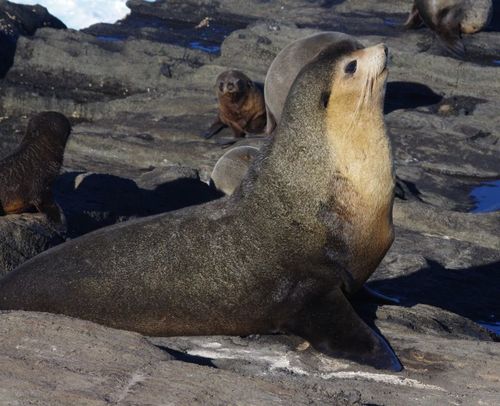
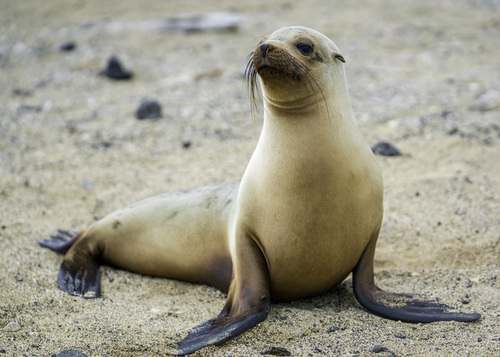
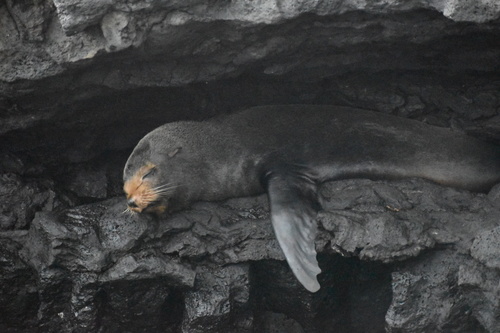
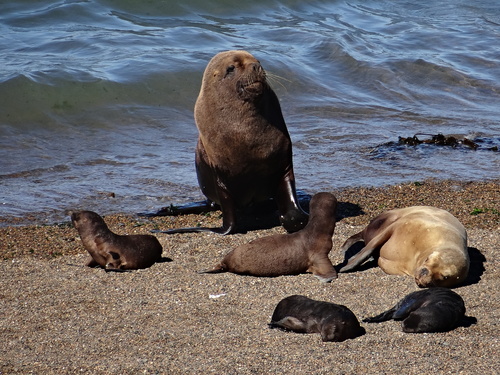
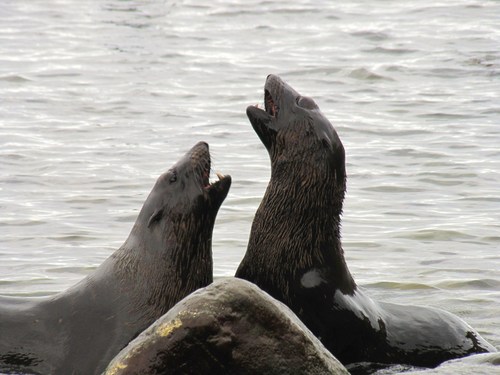
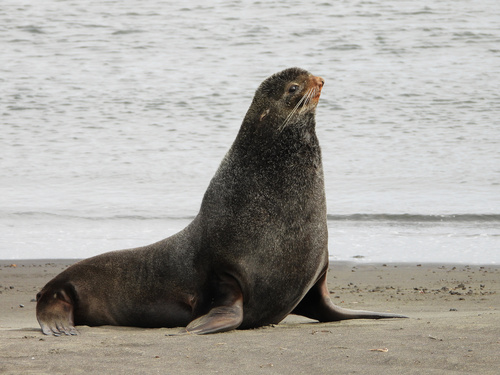
Callorhinus ursinus, the northern fur seal, displays extreme sexual dimorphism: adult males are 30–40% longer and more than 4.5 times heavier than adult females. Both sexes have a foreshortened head, thanks to a very short, down-curved muzzle and small nose; the nose extends slightly beyond the mouth in females, and moderately further in males. Their pelage is thick and luxuriant, with a dense creamy-colored underfur that is obscured by longer guard hairs, though it becomes partially visible when the animal is wet. Unique, diagnostic features mark both the fore and hind flippers. No fur grows on the top of the fore flippers, which leaves a distinct abrupt "clean line" across the wrist where fur ends. The hind flippers are proportionally the longest of any otariid, caused by extremely long cartilaginous extensions on all toes. Small claws sit on digits 2–4, placed well back from the flap-like end of each digit. The ear pinnae are long and conspicuous, and the tips are free of dark fur in older animals. The mystacial vibrissae can grow very long, regularly extending past the ears. Vibrissae color follows age: adults have all white vibrissae, juveniles and subadults have a mix of white and black (including some with dark bases and white ends), and pups and yearlings have all black vibrissae. The eyes are proportionally large and conspicuous, most noticeably in females, subadults, and juveniles. Adult males have a stocky build with enlarged thick, wide necks. A mane of coarse, longer guard hairs runs from the lower neck to the shoulders, covering the nape, neck, chest, and upper back. While adult male skulls are large and robust for their overall body size, their heads appear short due to the combination of a short muzzle and the back of the head behind the ear pinnae being obscured by the enlarged neck. Adult males have abrupt foreheads formed by elevation of the crown from sagittal crest development, plus thicker mane fur on the top of the head. Adult male canine teeth are much longer and greater in diameter than adult female canines, and this size difference holds to a smaller degree across all age groups. Adult females, subadults, and juveniles have moderate builds, and distinguishing between sexes is difficult until individuals reach approximately five years of age. Their bodies are modestly sized, and the neck, chest, and shoulders are proportional to the torso. Adult females and subadults have more complex, variable coloration than adult males. They are dark silver-gray to charcoal on their upper sides. The flanks, chest, sides, and underside of the neck—often forming a chevron pattern in this area—range from cream to tan with rusty tones. Variable cream to rust-colored markings appear on the sides and top of the muzzle, chin, and as a "brush stroke" running backward under the eye. In contrast, adult males are solid medium gray to black, or reddish to dark brown across their entire body. The guard hairs of their manes can have variable amounts of silver-gray or yellowish tinting. At birth, pups are blackish, with variable oval buff-colored patches on the sides, axillary area, chin, and sides of the muzzle. After three to four months, pups molt into the coloration of adult females and subadults. Maximum body sizes are: males up to 2.1 m (6 ft 11 in) long and 270 kg (600 lb), females up to 1.5 m (4 ft 11 in) long and 50 kg (110 lb) or more, and newborns 5.4–6 kg (12–13 lb) and 60–65 cm (24–26 in) long. Northern fur seal teeth are haplodont: sharp, conical, and mostly single-rooted, which is typical for carnivorous marine mammals adapted to tearing fish flesh. Like most caniforms, their upper canines are prominent. The adult dental formula is 3.1.4.2 / 2.1.4.1. Like other otariids, northern fur seals are built for efficient movement on land. Their hind limbs adopt a plantigrade stance and can rotate under the body to enable quadrupedal locomotion and support. When in water, they use two types of movement: general locomotion and diving. These seals primarily swim using forelimb propulsion due to their physiology. They have flexible intervertebral joints that improve underwater maneuverability and provide greater muscular leverage for pectoral strokes. Stroke patterns differ between dive types and general locomotion, and stroke rates vary between individuals, as maximum stroke rate correlates with body size. The northern fur seal inhabits the North Pacific Ocean; its southern range boundary runs roughly from the southern tip of Japan to the southern tip of the Baja California Peninsula, and it also occurs in the Sea of Okhotsk and the Bering Sea. An estimated 1.1 million northern fur seals live across their full range. Roughly half of the total population breeds on the Pribilof Islands in the eastern Bering Sea. Another 200–250 thousand breed on the Commander Islands in the western Bering Sea, around 100,000 breed on Tyuleniy Island off the coast of Sakhalin in the southwest Sea of Okhotsk, and 60–70 thousand breed in the central Kuril Islands of Russia. Smaller breeding rookeries, holding around 5,000 animals each, are found on Bogoslof Island in the Aleutian Chain, San Miguel Island in the California Channel Island group, and South Farallon Island off the coast of California. Stable isotope analysis of Holocene northern fur seal bone collagen (δ13C and δ15N) shows that before the maritime fur trade, the species more commonly bred at local rookeries in British Columbia, California, and likely along most of the northwest coast of North America. During winter, northern fur seals undergo a net southward migration: individuals from Russian rookeries regularly enter Japanese and Korean waters of the Sea of Japan, while Alaskan individuals move along the central and eastern Pacific to British Columbia, Canada, and as far south as Baja California. The northern fur seal's range overlaps almost exactly with that of Steller sea lions, and the two species occasionally cohabit at reproductive rookeries, most notably in the Kuril Islands, Commander Islands, and Tyulen'i Islands. The only other fur seal found in the Northern Hemisphere is the Guadalupe fur seal, which has a slight range overlap with the northern fur seal in California. Northern fur seals are opportunistic feeders that primarily eat pelagic fish and squid, with diet varying based on local prey availability. Confirmed fish prey includes anchovy, hake, herring, saury, lantern fish, rockfish, capelin, salmon, pollock, and mackerel. Their feeding behavior is primarily solitary. Northern fur seals are mainly preyed on by sharks and killer whales. Occasionally, Steller sea lions eat very young northern fur seals, and Arctic foxes have been observed preying on live northern fur seal pups. Pup mortality is relatively high, due to very high pup densities on reproductive rookeries and mothers beginning their foraging trips at an early age. As a result, pup carcasses are an important food source that enriches the diet of many scavengers, particularly gulls and Arctic foxes. In 2017, 14 samples of spiny lice were collected from the nasal passages of northern fur seal pups. In 2021, these spiny lice were identified as having a unique bristle arrangement, and were described as the new species Antarctophthirus nevelskoyi, named after famous Russian explorer Admiral Gennady Ivanovich Nevelsky.