About Callorhinchus milii Bory de Saint-Vincent, 1823
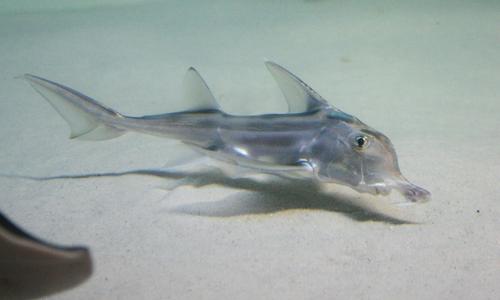
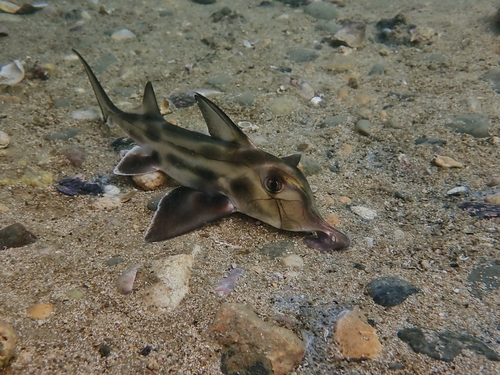
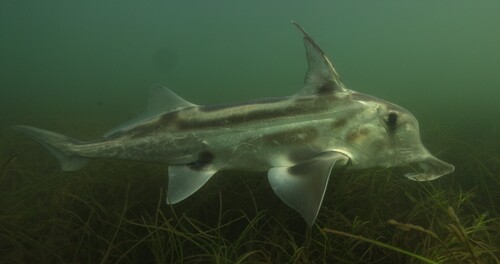
Callorhinchus milii Bory de Saint-Vincent, 1823 is a fish that is silvery in color with iridescent reflections and dark, variable markings along its sides. Males reach maturity at 50 cm (1.6 ft) in total length, while females mature at 70 cm (2.3 ft); the maximum recorded head-to-tail length for this species is 1.5 m (4.9 ft). It has an elongated, smooth, torpedo-shaped body, with two triangular dorsal fins spaced widely apart. Individuals use their hoe-shaped snouts to probe the ocean floor for invertebrates and small fish to feed on. From spring through autumn, adult fish migrate inshore to estuaries and bays, where females lay their eggs on sandy or muddy substrates. The eggs are held inside large yellowish capsules. After a few months, the egg case partially opens to allow seawater to flow into the egg. Juveniles hatch out of the capsule after six to eight months, measuring around 12 cm (4.7 in) in length. The maximum estimated age for this species is 15 years. This fish has three cone pigments for color vision, a trait it shares with humans. Its dorsal fin bears a very sharp spine. While this spine has been reported to be venomous, no serious human injuries from it have been documented so far. This species is currently recognized as native to waters off southern Australia and New Zealand. It has been hypothesized that the New Zealand population and the Australian population may actually be two separate species.