About Callorhinchus capensis Duméril, 1865
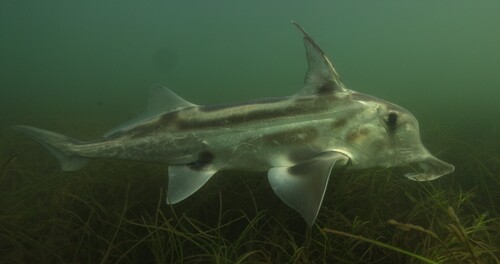
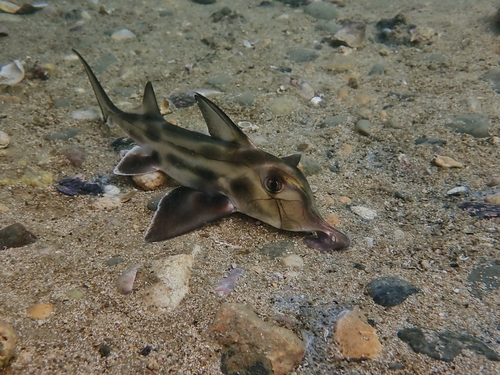
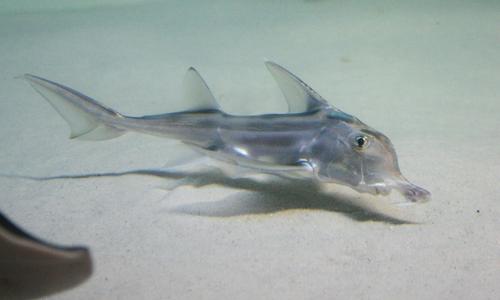
Adult Cape elephantfish (Callorhinchus capensis) measure 45 to 120 centimetres (1.48 to 3.94 ft) in length and weigh 3 to 5 kilograms (6.6 to 11.0 lb), with females typically larger than males. Their body color ranges from silver to bronze, and they usually have a more yellowish hue than other close relatives in the genus Callorhinchus. A dark band runs along the middle of their back, interrupted by their dorsal fins, and their fins are generally slightly darker than the rest of the body. They have two dorsal fins spaced widely apart on the back, with the second dorsal fin slightly longer than the first. The first dorsal fin starts ahead of where the pectoral fins attach to the body, and bears a long venomous spine on its front edge; the upper three-quarters of this spine is free from the fin, and its tip is serrated. The second dorsal fin starts behind the base of the pelvic fins and ends right at the base of the caudal (tail) fin. The caudal fin is heterocercal, meaning the vertebral column extends into the upper lobe, and is split into two lobes separated by a deep notch. Cape elephantfish have enlarged pectoral fins that let them swim slowly along the bottom of the water column; this feature, along with their reduced caudal fin, is an adaptation to a slow-moving deep-water lifestyle shared by many similar fish. The most distinctive feature of the genus Callorhinchus is the proboscis, which is flat and depressed at its base, narrow and compressed at its end. It has a curve at the tip, with a thin cutaneous membrane behind this curve. This skin flap is three times as long as it is wide, which distinguishes Cape elephantfish from other members of the genus. The proboscis is structured with cartilage, over which the skin of the upper lip is stretched. They have vertical pupils. The genus can also be told apart from related groups by its smaller, more pointed upper front teeth. Males have paired, kidney-shaped testes that increase in mass as the fish approaches sexual maturity. The sperm of Cape elephantfish is packaged into 1mm spermatophores, which are suspended in a green gelatinous matrix. As they grow, males develop several secondary sexual characteristics: claspers on the inner edge of their pelvic fins that average 8.9 centimetres (3.5 in) in length, two tenacula positioned anterior to the pelvic fins, and a large flexible frontal tenaculum at the center of the forehead. The claspers and paired tenacula allow males to grasp females during mating. The frontal tenaculum is covered in denticles (enameloid-covered scales structurally similar to teeth), which harden as the animal reaches sexual maturity. Females develop a nidamental gland, and their ovaries increase in mass as they mature; they do not develop any secondary sexual characteristics, but mature females often retain a semen plug after insemination. This plug starts as a translucent, waxy, dark green substance, and becomes paler and softer as eggs develop inside the female. Cape elephantfish egg cases are leathery and oval-shaped, measuring about 18 centimetres (7.1 in) long. One side of the egg case is smooth, the other is hairy, and the outer edge has a frill. Cape elephantfish are found on continental shelves in waters surrounding South Africa, and are the only member of the genus Callorhinchus present in this region. They have been recorded as far north as Natal, and also occur off Namibia. They can be found at depths down to 399 metres (1,309 ft), but become less common as depth increases. Cape elephantfish prefer habitats in sheltered bays with cold, murky water and soft substrate. Juveniles are usually found closer to shore, while larger adults occur further from shore and at greater depths. They only live in salt water, and are never found in brackish or fresh water. Cape elephantfish feed on bottom-dwelling invertebrates that live in the soft substrate of their habitat, using their proboscis to probe the substrate for food. They most commonly eat bivalves, most frequently Phaxas decipens, and crustaceans, but occasionally consume gastropods such as Nassarius speciosus, polychaetes, and even small fish like the Southern African anchovy (Engraulis capensis). Cape elephantfish are nocturnal, more active at night than during the day. They are preyed on by Cape fur seals and sharks. Recent research suggests seals prey on Chondrichthyans more often than previously thought. This was hard to detect because these fish leave no hard parts such as bones or otoliths for researchers to find in seal scat, unlike bony teleost fish. Chondrichthyans including Cape elephantfish are preyed on by pinnipeds at depths of at least 600m off the coasts of Namibia and South Africa. Cape elephantfish are particularly vulnerable because they are the only chondrichthyan in the southeastern Atlantic that regularly uses shallow water. Researchers monitoring Cape fur seals have found many seals dead or injured from Cape elephantfish spines embedded in their necks. Pinnipeds like Cape fur seals typically shake their prey after catching it, and this movement may cause the fish's spines to become lodged in the seals' necks. This discovery indicates that chimaeras such as Cape elephantfish are preyed on by seals more often than previously recorded, suggesting a shift in food web dynamics that may stem from a lack of other more suitable prey for Cape fur seals. Predatory gastropods often feed on chondrichthyan eggs by boring holes through the leathery casing to eat developing embryos, but researchers have found Cape elephantfish eggs are less susceptible to this predation. When Cape elephantfish eggs wash up on shore, they are often damaged or already hatched, but are rarely predated by gastropods. This may be because the eggs are laid in sand, rather than reefs where gastropods are more abundant. Adult Cape elephantfish spend most of their time in deep water, but during the summer, breeding adults gather inshore to mate and lay eggs. Mating occurs over a long period: it is concentrated in summer, but continues throughout the year, and females may mate more than once per year. During breeding, females produce between one and 22 eggs, and produce more eggs as they age. Unfertilized eggs are often reabsorbed during winter to let the female conserve energy. Cape elephantfish eggs are often found in Robberg Marine Protected Area, indicating the area hosts a large nursery for the species. Cape elephantfish are primarily fished between Mossel Bay and Elands Bay, where around 700 to 900 tons are landed each year. Though they were originally considered trash fish, they are now the most common cartilaginous fish species targeted by fisheries and landed as bycatch off the Cape of South Africa, and have some importance to local fisheries and fishermen. They are caught using gillnets, beach seines, and as bycatch in demersal trawling. Cape elephantfish is the only Chondrichthyan that is not released when caught in beach seine nets on the west coast of South Africa; other chondrichthyans commonly caught in this fishery, including smoothound shark, lesser sandshark, blue stingray, and eagle ray, are all required to be released under permit restrictions. In this region, the minimum stretched mesh size for the wings of beach-seine nets is 48mm, and 44mm for the codend. The minimum stretched mesh size for gillnets is 176 to 180 millimetres (6.9 to 7.1 in).