About Callorhinchus callorynchus (Linnaeus, 1758)
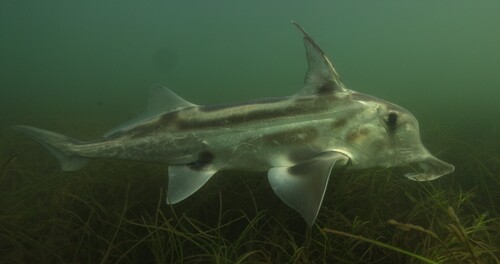
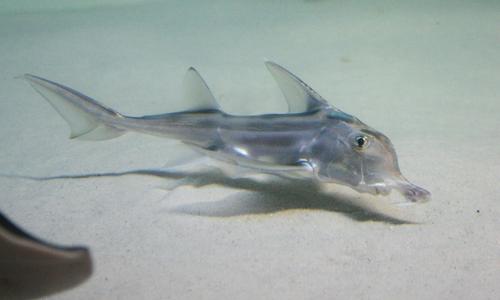
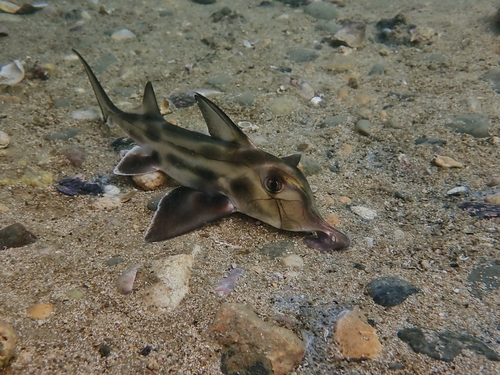
Callorhinchus callorynchus (Linnaeus, 1758) has a silver to gray body, with prominent brown spots concentrated on the dorsal half of the fish and on the fins. Pink hues also appear around the mouth and fins. This species forages for prey through benthic foraging, meaning it sifts through sludge on the ocean floor. Its sub-terminal plough-shaped snout is adapted to crush invertebrate prey, including scallops, mollusks, and other benthic invertebrates. Its strong jaws hold tooth plates, mouth structures specifically designed to crush hard-shelled prey. This species displays sexual dimorphism: females reach lengths of up to 102 centimeters, while males grow to approximately 85 centimeters. Newly born juveniles measure around 13 centimeters in length. Callorhinchus callorynchus is predominantly found in the coastal waters of southern Brazil, Peru, Chile, Argentina, and Uruguay. It inhabits the open seas of the southeast Pacific Ocean and southwest Atlantic Ocean, and prefers depths of approximately 200 meters. During its reproductive cycle, which includes mating and egg-laying periods, this fish migrates to shallow coastal waters. It is closely related to the Australian ghostshark (C. milii), which lives on sea floors around Australia in the southwest Pacific Ocean, and the Cape elephantfish (C. capensis), found off the coast of South Africa.