About Callitris baileyi C.T.White
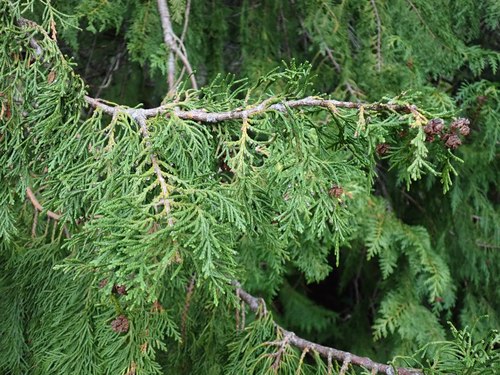
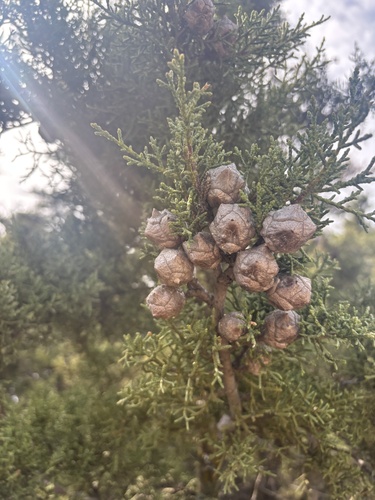
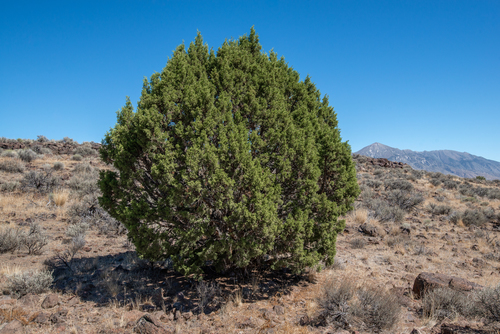
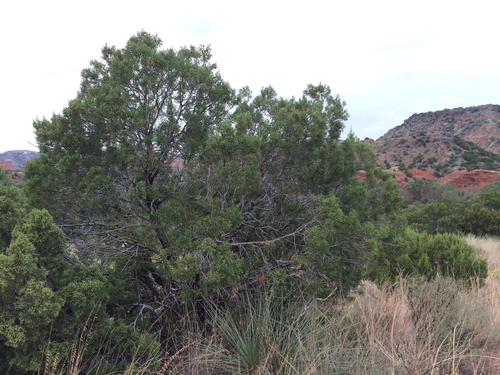
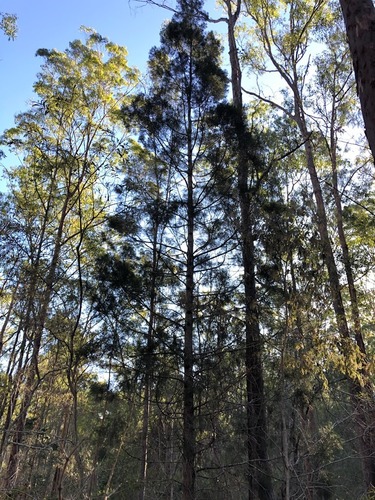
Callitris baileyi is a slender tree that grows up to 18 meters tall. It has rough, greyish bark and a green crown. Adult leaves are green, average 25 millimeters long, and arranged in groups of three that run parallel to the stem. Leaf bases extend down stems as wings, creating a grooved appearance on branchlets. Cones grow on separate, solitary slender fruiting branchlets. This species is monoecious, meaning both male and female cones develop on the same tree. Male cones grow at the tips of branchlets and are 2–3 mm long. Developing female cones grow on waxy, greyish-blue branchlets. Mature female cones are oblong, 10–13 mm in diameter, and covered with short, narrow alternating scales. The central cone stalk is short, narrow at the base, and slightly angled. It produces few seeds, each with only two unequal wings. Callitris baileyi occurs sporadically in southeast Queensland, Australia. There are over ten known locations ranging from the Queensland state border to Goomeri, and west to the Bunya Mountains. Smaller patches grow on private land and in Koreelah National Park, west of Woodenbong. Habitat fragmentation across the species' range has severely reduced all existing subpopulations. The species was previously found at Acacia Creek and Sandilands near Tabulam in New South Wales, but it no longer grows in these areas. Callitris baileyi grows on rocky slopes in hilly or mountainous terrain, in shallow, often clay soils. Its total extent of occurrence is between 15,000 and 25,000 km². It grows in eucalypt woodland, where it is commonly associated with ironbark, blue gum and spotted gum. Subpopulations in New South Wales grow in open grassy eucalypt forest near creeks. The overall population of Callitris baileyi has declined enough for the species to be classified as Near Threatened under IUCN 3.1 criteria. The main cause of decline is inappropriate fire regimes, particularly frequent low-intensity burning carried out to reduce fuel loads and promote grass growth for cattle grazing or agriculture. Over time, this burning prevents the species from regenerating and can eliminate entire subpopulations. Habitat fragmentation is especially common outside of protected national park areas. Invasive alien weeds are another driver of habitat decline; the invasive shrub Lantana camara is a documented threat to parts of the species' Queensland range. Currently, New South Wales state legislation lists Callitris baileyi as Endangered, while Queensland lists it as Near Threatened. The species has been recorded in multiple national parks, including Bunya Mountains National Park in Queensland and Koreelah National Park in New South Wales.