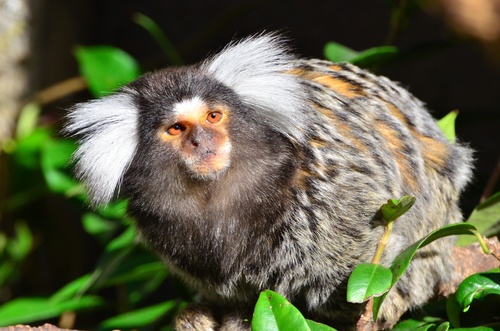
About Callithrix jacchus (Linnaeus, 1758)
Common marmosets (Callithrix jacchus) are very small monkeys with relatively long tails. Males are slightly larger than females: males have an average height of 188 mm (7.40 in) and an average weight of 256 g (9.03 oz), while females have an average height of 185 mm (7.28 in) and an average weight of 236 g (8.32 oz). The species' fur (pelage) is multicolored, sprinkled with brown, grey, and yellow. Common marmosets have distinctive white ear tufts, a banded tail, black skin across the nose area, and a white marking on the forehead. Infant common marmosets have brown and yellow coats, and their ear tufts develop as they mature. Like other members of the genus Callithrix, common marmosets have claw-like nails called tegulae on most of their fingers. Only their big toes (halluces) have the flat nails (ungulae) found in most other primates. Their claw-like nails are an adaptation for their arboreal squirrel-like locomotion, which includes clinging vertically to trees, leaping between trees, and running quadrupedally across branches. Shared traits across the genus Callithrix also include enlarged, chisel-shaped incisors and specialized ceca adapted to the species' diet. Common marmosets are native only to east-central Brazil, but have been introduced to other areas, and now live in the cities of Rio de Janeiro (Brazil) and Buenos Aires (Argentina). They occupy a range of forest habitats, including Atlantic coastal forests, inland semideciduous forests, savanna forests, and riverine forests. They also thrive in dry secondary forests and forest edge habitats. Common marmosets have a complex mating system. While they were long thought to be strictly monogamous, both polygamy and polyandry have been observed in the species, though most matings are still monogamous. Even in groups that contain two breeding females, the subordinate female often mates with males from outside the group. Subordinate females rarely produce viable offspring, and mating with extra-group males may allow them to find potential future mates. Females that successfully mate but lose their young will typically move to other groups, and may gain dominant breeding positions in these new groups. Breeding individuals in a common marmoset group rely on other group members to help raise their young. Because of this, the dominant breeding pair behaviorally and physiologically suppresses reproduction in other group members. Most suppressed individuals are related to the breeding pair, so they share genes with the pair's offspring, giving them an incentive to help care for the young. The presence of a related male also impacts female ovulation: female ovulation does not occur when their father is nearby, but does occur when an unrelated male is present. Young adult females may also act aggressively towards their mothers, possibly to displace them from dominant positions. When conditions allow breeding, adult females breed regularly for the rest of their lives. Females solicit mating from males by flicking their tongues. The gestation period lasts 5 months, and females become ready to breed again approximately 10 days after giving birth. With 5 months between each birth, females can give birth twice per year. Common marmosets commonly give birth to nonidentical twins. This puts females under high stress during pregnancy and lactation, so they rely on help from other family group members to raise offspring. For the first two weeks of life, infant marmosets instinctively cling to their mother's back and do not voluntarily let go. After this period, infants become active and begin exploring their environment. The breeding male (typically the father) starts handling the twins, and all group members participate in caring for the young. Over the following weeks, young marmosets spend less time on their mother's back and more time moving and playing. Infants are weaned at 3 months old. They enter the juvenile stage at 5 months old, when they interact more with group members besides their parents; rough play during this stage helps establish their future social status. When a new litter of infants is born, older juvenile marmosets will carry and play with the new young. Common marmosets become subadults between 9 and 14 months old; at this stage they behave like adults and go through puberty. They reach full adult size and sexual maturity at 15 months old, but cannot breed until they attain a dominant social position.