About Calliteara pudibunda Linnaeus, 1758
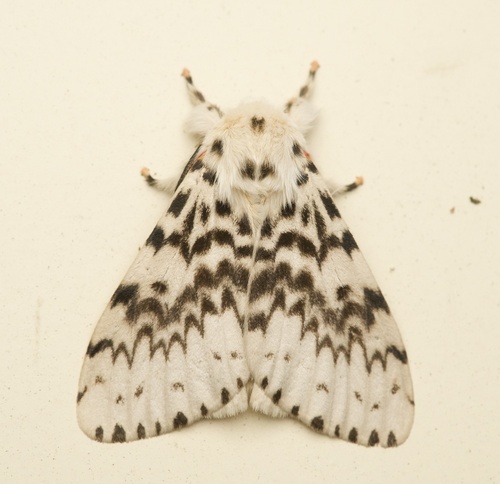
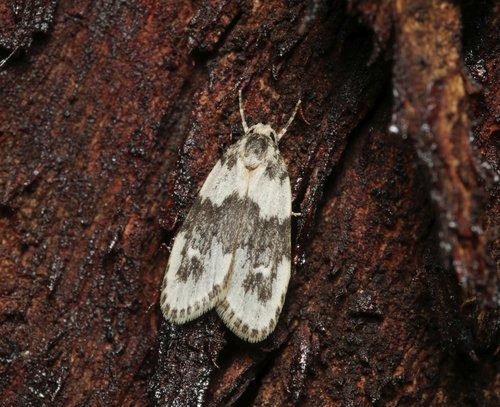
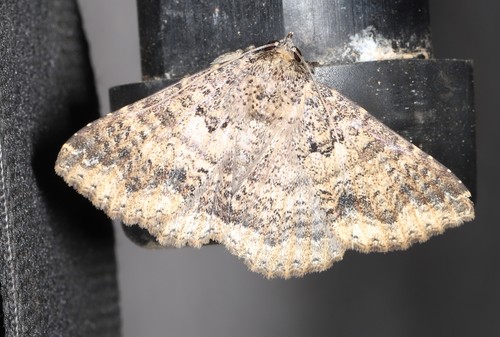
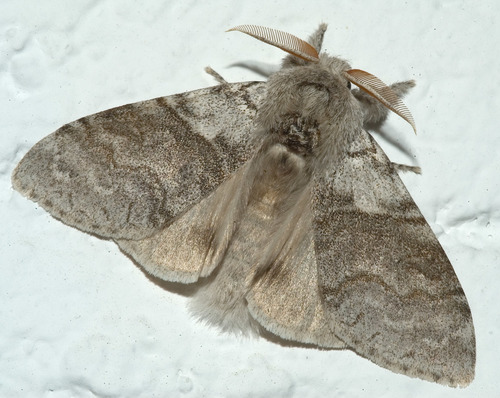
Calliteara pudibunda is a moth species first described by Linnaeus in 1758. It is a known pest of European beech forests dominated by Fagus sylvatica. Tree species composition impacts this moth, which reacts very sensitively to even small portions of spruce trees growing within beech stands. The wingspan of adult moths ranges from 40 to 60 mm. Females have greyish white forewings dusted with dark pigment, marked by dark wavy transverse lines that have pure white edging along their inner side. Their hindwings are white, with faint dark markings indicating a submarginal band. Males have olive grey forewings, with a black median area and darker, indistinct, slightly wavy transverse lines in both the marginal and basal areas. Their hindwings are greyish yellow, with a transverse band that is slightly more distinct than the band on female hindwings, and sometimes forms an elbowed shape near the anal area. Form juglandis Hübner is a divergent variant of this species. In male form juglandis, the head and thorax are greyish white, compared to the dark brown or only slightly lighter coloration of these parts in typical specimens. The forewing basal area is also whitish in this form. The median area is grey, with a blackish discocellular spot and marginal lines. The hindwing has a distinct dark submarginal band and a discocellular spot. In female form juglandis, the hindwing submarginal band is also more distinct than it is in typical Calliteara pudibunda females. Aberration concolor Staudinger has dark grey forewings that are uniformly colored, or only show faint traces of the usual transverse lines. This species is distributed across Europe, Anatolia, the Caucasus, western Siberia, eastern Transbaikalia, the Amur basin of southeastern Russia, Korea, China, and northern Vietnam.