About Callistosporium luteo-olivaceum (Berk. & M.A.Curtis) Singer
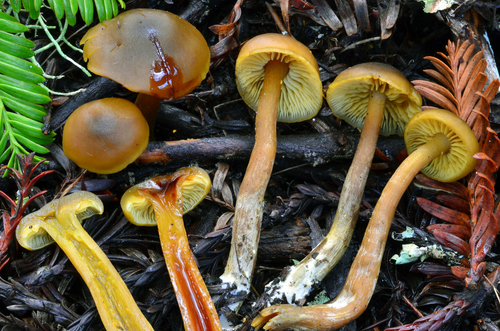
Callistosporium luteo-olivaceum is a species of agaric fungus in the family Callistosporiaceae. It was first described as Agaricus luteo-olivaceus by Miles Joseph Berkeley and Moses Ashley Curtis in 1859. Rolf Singer moved the species to the genus Callistosporium in 1946. This fungus has an extensive list of synonyms. Its brownish fruiting body produces a cap that grows up to 4.5 centimetres (1+3⁄4 inches) wide. The gills are yellowish and closely spaced. The stem is 7 centimetres (2+3⁄4 inches) long, fibrillose, and hollow, with yellowish tomentum near its base. The spores are colorless; they produce a whitish spore print, and turn yellow when placed in ammonia. This species can look similar to Tricholomopsis aurea, T. sulfureoides, and Gymnopilus picreus. While it is rare, C. luteo-olivaceum is widely distributed across temperate and tropical areas of Europe and North America. In 2014, it was documented growing in pine forests in the Western Himalaya, Pakistan. This species is classified as inedible.