About Callistoctopus ornatus (Gould, 1852)
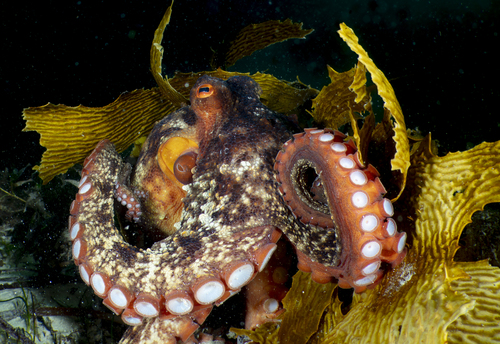
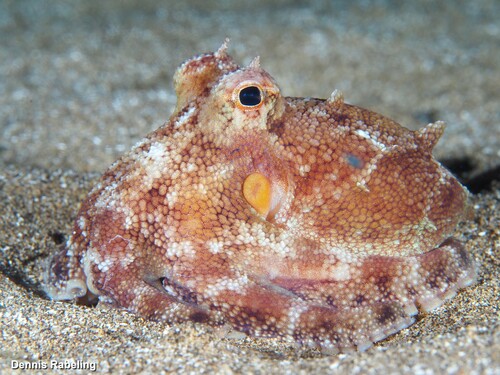
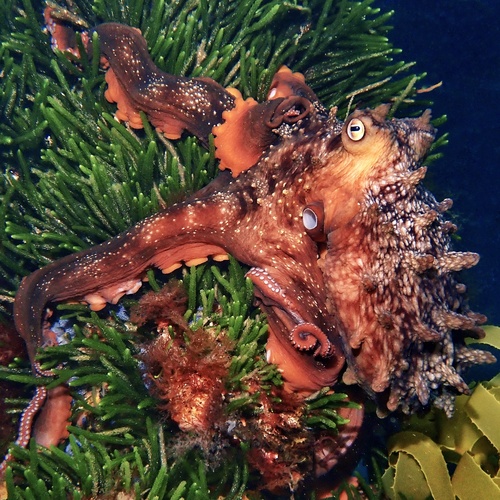
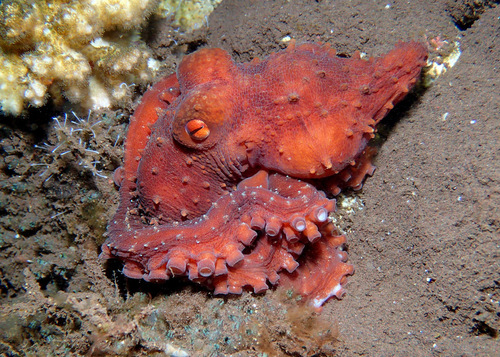
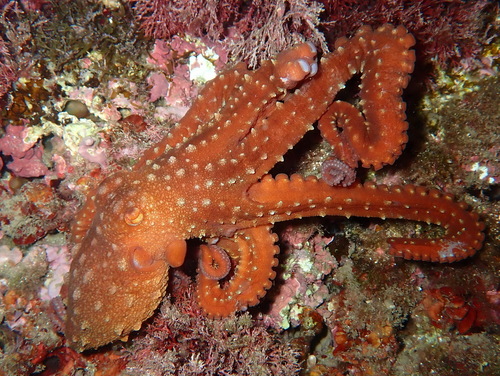
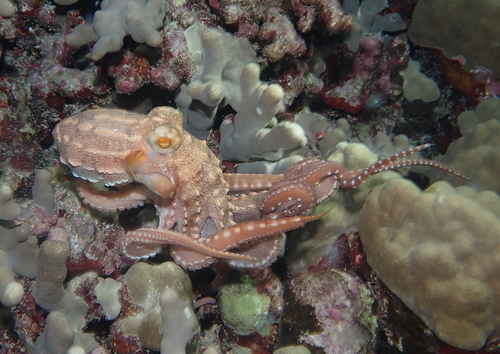
Callistoctopus ornatus, formally described by Gould in 1852, has upper arms that are much longer and thicker than its other arms. Its body colour ranges from pink to red, with paired white spots running down the arms and short longitudinal white stripes on the mantle. This species can reach several kilograms in weight, with a maximum armspan of up to 2 metres (6 ft 7 in). Its body is oval-shaped to elongate, and it has large eyes. The arms are approximately six times the length of the body, with the front pair being the longest. Each arm has two rows of suckers, the connecting webs between the arms are shallow, the skin is fairly smooth, and long flaps can be raised within the white stripes along the sides of the body. This species has one of the widest distributions of any octopus, a trait linked to the planktonic life stage of its hatchlings. It occurs across all tropical Indo-Pacific waters, ranging from Hawaii and Easter Island in the east to South Africa in the west. In Australian waters, it is found from northern New South Wales, around the entire northern Australian coastline, to Perth in Western Australia. Its distribution is generally restricted to tropical waters within the 20 °C (68 °F) isotherm. Specimens collected from the warm temperate waters of New South Wales are most likely the result of planktonic juveniles being carried south by the warm East Australian Current. Adult C. ornatus are usually found on coral reefs. On the southern Great Barrier Reef, their lairs are deep vertical holes excavated into coral rubble, and individuals seal the lair entrance with rubble during the day. Nothing is currently known of this species' mating behaviour. Females can lay up to 35,000 small eggs, each measuring around 2 millimetres (0.08 in) long. After hatching, young octopuses swim up into the plankton and are dispersed by surface currents, before eventually settling on a new coral reef to develop into adults. This octopus is harvested by subsistence hunters across its entire range. Historically, Polynesian Hawaiians collected this species by using torches to locate foraging individuals at night, then killing them with hand spears.