About Callistoctopus macropus (Risso, 1826)
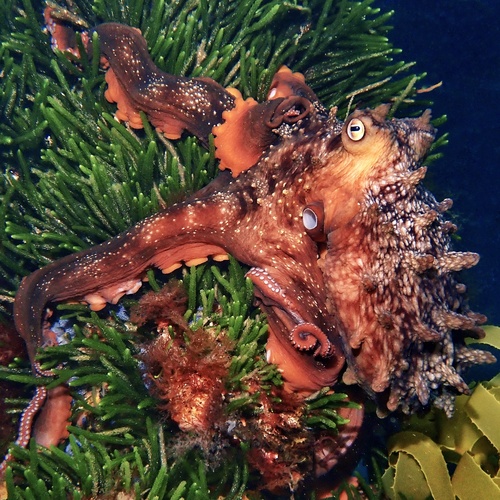
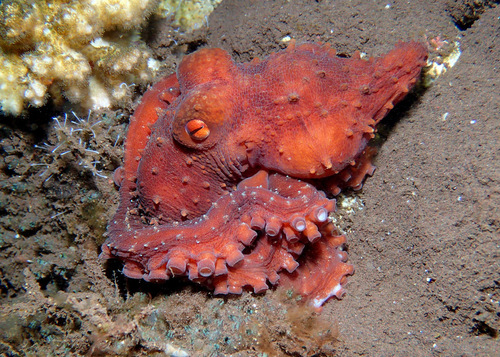
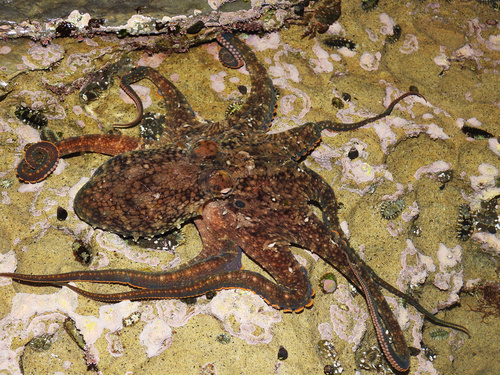
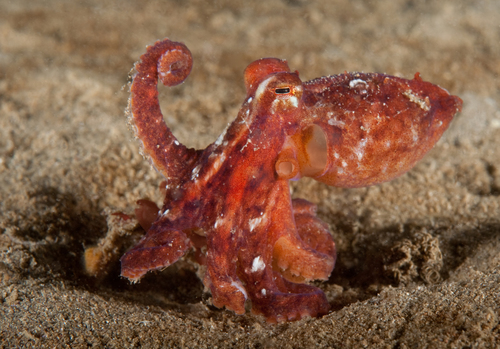
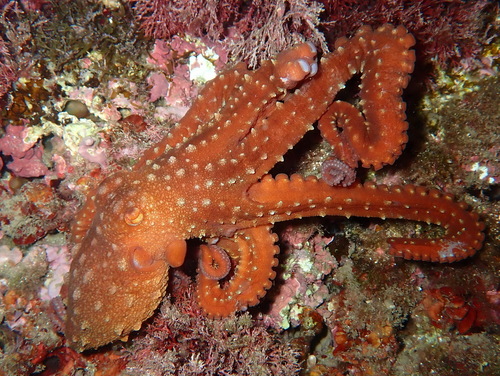
Callistoctopus macropus reaches a mantle length of 20 cm (8 in) and a total length of 150 cm (59 in). Its first pair of arms is around one metre long, which is far longer than its other three pairs of arms. All of its arms are connected by a shallow web. This octopus is red, with white blotches across its body and paired white spots along its arms. When disturbed, its colour becomes more intense; this is deimatic behaviour that may make it appear threatening to potential predators. Populations of Callistoctopus macropus form a species complex that occurs in the Mediterranean Sea, the temperate and tropical Atlantic Ocean, the Caribbean Sea, the Pacific Ocean, and the Indian Ocean. It lives close to shore at depths down to roughly 17 m (56 ft), and favours habitats of sand, rubble, or seagrass meadows. It will sometimes bury itself under sand. Callistoctopus macropus has a more selective diet than the common octopus (Octopus vulgaris), which shares part of its range and feeds during the day. In contrast, Callistoctopus macropus feeds at night. It forages by moving between clumps of branching coral, often species from the Acropora or Stylophora genera. The octopus wraps its mantle around a coral head and probes between the coral branches with its arms, searching for small fish and invertebrates that hide among the branches for protection. When this octopus feeds, a number of groupers from the family Serranidae and other predatory fish associate with it, and pounce on small organisms that the octopus flushes out of the coral head. For many years, the breeding habits of this octopus remained unknown. Researchers later observed a female attaching short-stalked eggs measuring 4 by 1.2 mm (0.16 by 0.05 in) to a hard surface, where the eggs formed a connected sheet. The female then brooded the eggs, caring for them by aerating and cleaning them. Like most octopus species, the female stopped feeding once she laid her eggs and died shortly after they hatched. The planktonic larvae that hatch from the eggs are each around 5.5 mm (0.2 in) long, with short arms that each have seven suckers. These larvae feed on zooplankton such as crustacean larvae.