About Callistemon viminalis (Sol. ex Gaertn.) G.Don
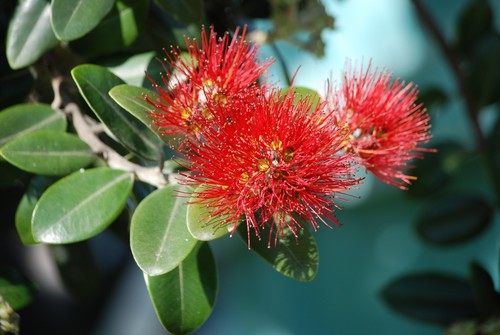
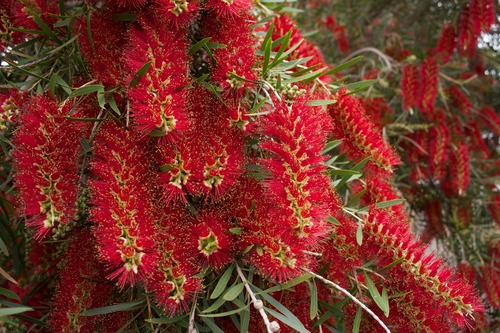
Melaleuca viminalis (formerly classified as Callistemon viminalis (Sol. ex Gaertn.) G.Don) is a large shrub or small tree that grows up to 10 meters (30 feet) tall. It has hard, fibrous, furrowed bark, multiple trunks, and typically pendulous branches. Its leaves are arranged alternately, measuring 25–138 mm (1–5 in) long and 3–27 mm (0.1–1 in) wide. The leaves are more or less flat, shaped from very narrow elliptical to narrow egg-shaped with the narrower end at the base, and taper to a sharp point at the tip. They have a single mid-vein, 9 to 27 lateral veins, and a large number of visible oil glands. The flowers are bright red, arranged in spikes on and around the ends of branches that continue growing after flowering. The flower spikes are 35–50 mm (1–2 in) in diameter and 40–100 mm (2–4 in) long, holding 15 to 50 individual flowers. The petals are 3.4–5.9 mm (0.1–0.2 in) long and drop off as the flower ages. Stamens are arranged in five bundles around each flower; the bundles are sometimes indistinct, and each holds 9 to 14 stamens. Flowering occurs from September to December, and often happens sporadically through the rest of the year. After flowering, the plant produces woody capsule fruits that are 3.8–4.8 mm (0.1–0.2 in) long and 5–6 mm (0.20–0.24 in) in diameter. This melaleuca is native to eastern Australia, occurring along eastern Queensland from Cape York Peninsula south to Moree and Grafton in New South Wales. A single specimen was apparently collected in Western Australia in 1991, but the Western Australian Herbarium classifies this species as alien to Western Australia. It mostly grows in and along watercourses, primarily in sandstone or granite terrain. Plants of the World Online records M. viminalis as native to New South Wales and Queensland, and introduced to The Bahamas, the Balearic Islands, California, the Canary Islands, El Salvador, Florida, India, Kenya, Madeira and Tanzania. Melaleuca viminalis provides food for nectivores. Its adaptations that let it survive strong currents during flood events allow it to slow floodwater flow and reduce erosion, which improves water quality in streams and rivers. The matted roots of this species also strengthen riverbank soil, further reducing erosion risk. It is a widely grown garden plant and street tree, most commonly known by its former name Callistemon viminalis. The species is extremely adaptable in cultivation. It flowers best in full sun, but is shade tolerant, though it produces fewer flowers when grown in shade. It grows in most soil types. It works well as a screening plant, and is suitable for planting as a street tree. It requires regular watering, but mature plants can survive drought. It is not frost hardy, and will be damaged or killed by salt spray. Many cultivars of this species have been developed and registered under the name Callistemon. They include: C. viminalis 'Captain Cook', a dwarf, compact shrub 1–2 m (3 ft 3 in – 6 ft 7 in) high; C. viminalis 'Dawson River Weeper', a fast-growing, rounded shrub up to 5 m (16 ft) high and wide with an exceptionally weeping growth habit; C. viminalis 'Hannah Ray', a shrub 4 m (13 ft) tall and 2 m (6 ft 7 in) wide with scarlet flower spikes; C. viminalis 'Hen Camp Creek', a shrub 3–4 m (9.8–13.1 ft) high and 2 m (6 ft 7 in) wide; C. viminalis 'Prolific', a small, fast-growing tree, 4–6 m (13–20 ft) high and 4 m (13 ft) wide; C. viminalis 'Rose Opal', a compact, dense shrub 1.5–1.8 m (4 ft 11 in – 5 ft 11 in) high; and C. viminalis 'Wild River', a semi-weeping form 4 m (13 ft) high and 2 m (6 ft 7 in) wide.