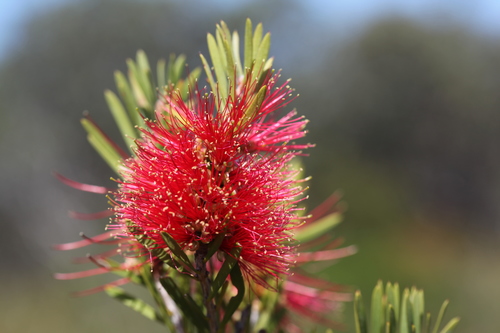
About Callistemon rugulosus (Link) DC.
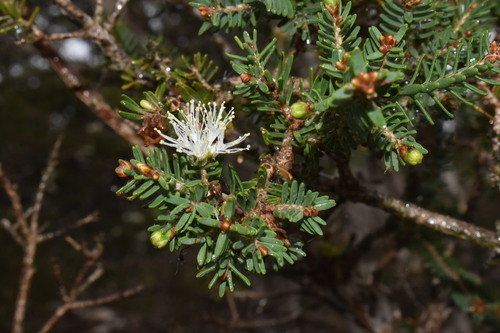
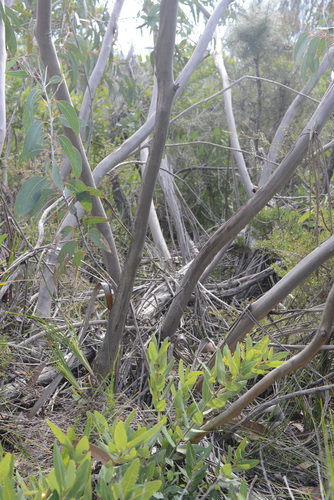
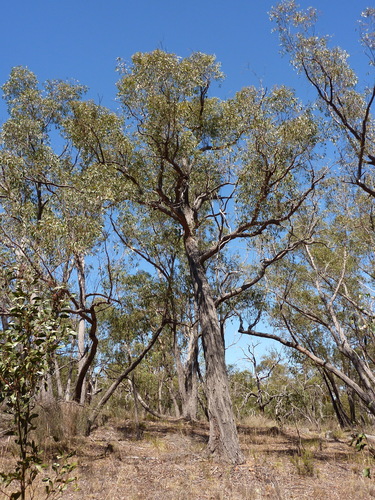
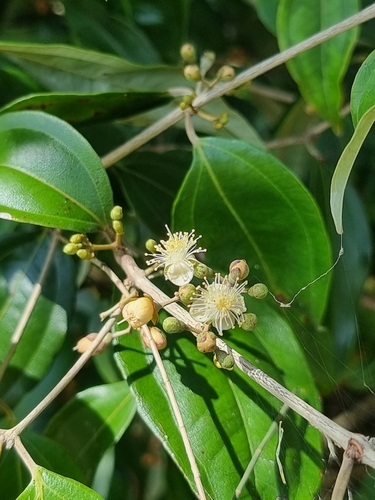
Melaleuca rugulosa (synonym Callistemon rugulosus (Link) DC.) is an open, straggling shrub that grows up to 5 metres (20 feet) tall, with peeling grey bark. Its leaves are arranged alternately along stems, measuring 21–86 mm (0.8–3 in) long and 2.5–8.5 mm (0.1–0.3 in) wide. The leaves are flat, thick, rigid, and shaped from narrow elliptic to egg-shaped with the narrower end at the base, ending in a sharp point. Each leaf has a mid-vein, marginal veins, and 7–13 indistinct lateral veins. Young leaves and new branches are often covered in dense, silky hairs. Flowers range in color from red to purple, with yellow tips, and arranged in spikes around branches that continue growing after flowering. The flower spikes are 40–65 mm (2–3 in) in diameter and 50–80 mm (2–3 in) long, containing 18 to 60 individual flowers. Petals are 4.4–6.8 mm (0.2–0.3 in) long and drop off as the flower ages; each flower has 34 to 63 stamens. Flowering typically occurs from November to December, and sometimes takes place in other months. Flowering is followed by the production of woody capsule fruits that are 4.5–6.5 mm (0.2–0.3 in) long. This melaleuca species is distributed from the southeastern corner of South Australia, including the Eyre Peninsula, to western Victoria. It grows in mallee scrubs and low open woodland in the northern Grampians, the Big Desert, the Little Desert, and the Mount Lofty Ranges. Within these regions, it occurs in sandy depressions and near watercourses in seasonally moist soils, and also grows in shrubland and forest near swamps and watercourses.