About Calliphora vomitoria (Linnaeus, 1758)
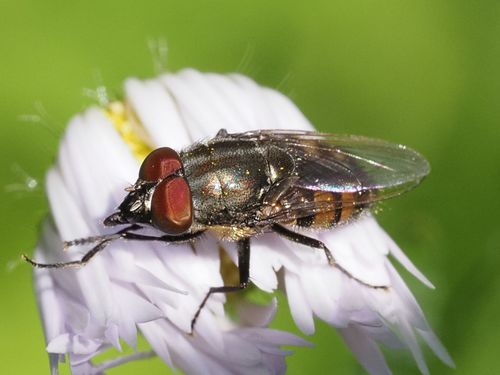
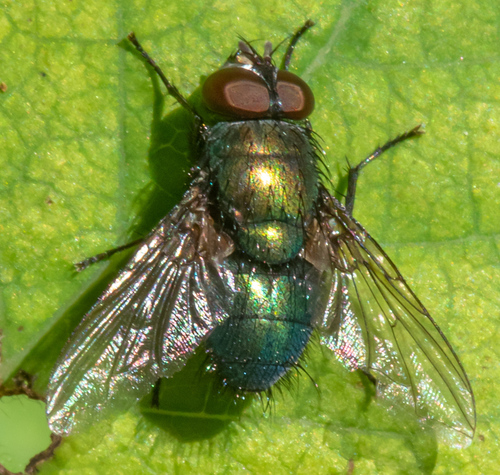
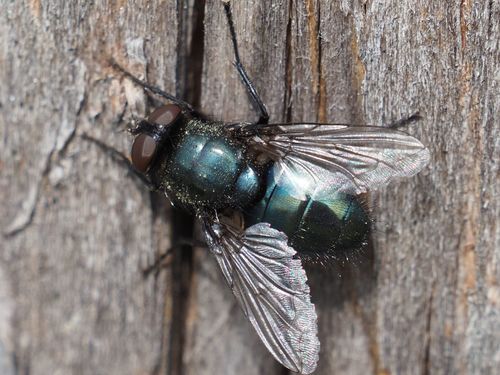
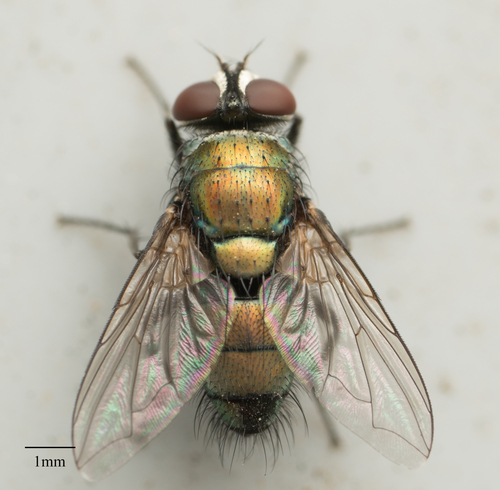
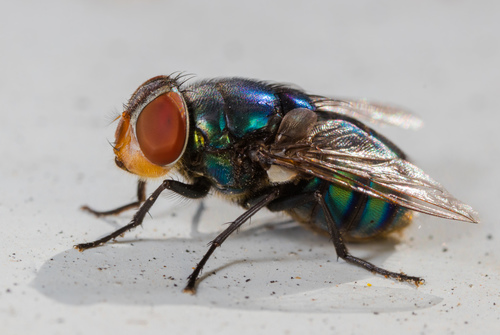
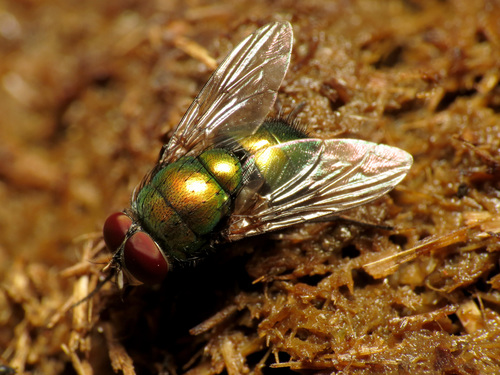
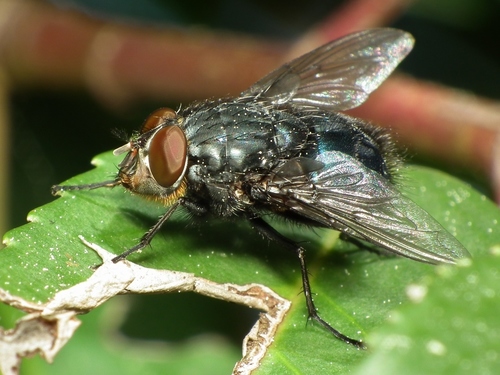
Calliphora vomitoria, commonly known as the blue bottle fly, is typically 10–14 mm (3⁄8–9⁄16 in) long, nearly twice the size of a housefly. Its head and thorax are dull gray, and the back of its head bears long yellow-orange setae. The abdomen is bright metallic blue with black markings, and its body and legs are covered in black bristly hairs. It has short, aristate antennae, four tarsi per leg, red eyes, and transparent wings. Its legs and antennae are black and pink, while its thorax (chest) is bright purple and bears protective spikes to defend against other flies. To distinguish C. vomitoria from close relatives like Calliphora vicina, look for its characteristic "orange cheeks" — orange hairs below the eyes — along with a dark basicosta (wing base); C. vicina has a yellow basicosta. All these identifying features can be seen clearly in a simple photograph. Correct identification of C. vomitoria is important because it is often not the only fly species found on carrion, and different species have different developmental cycles; misidentification can lead to incorrect estimates of time of death in forensic investigations. Historically, identification relied on simple morphological differences, but this is very difficult at crime scenes, where insect preservation is often poor. The most reliable methods for species differentiation use DNA, specifically mitochondrial DNA and the COI gene. Using the COI gene with restriction enzymes is a relatively fast, simple, and accurate method to distinguish between blowfly species. C. vomitoria is found across the world, including most of Europe, Alaska, Greenland, southern Mexico, the United States, and southern Africa. Compared to other Calliphoridae species such as Lucilia sericata and Chrysomya albiceps, it prefers higher elevations, and it is among the most abundant flies in these regions. Temperature strongly influences its distribution. Like most flies, C. vomitoria is most abundant in spring and summer, and least abundant in fall and winter. Its preferred habitat changes with season: in winter and summer, it is found mostly in rural areas, and less commonly in riparian areas; in spring and fall, it inhabits riparian areas. Blue bottle flies have a complete life cycle consisting of egg, larva, pupa, and adult stages, with total development usually taking around two weeks. Females lay their eggs in their feeding sites, most commonly decaying meat, garbage, or feces. Pale whitish larvae, commonly called maggots, hatch from the eggs and immediately begin feeding on dead animal carcasses and the decomposing matter where they hatched. After several days of feeding, the larvae reach full size, then crawl away to a drier spot, burrow into soil or similar substrate, and pupate inside tough brown cocoons. The pupal stage is the longest stage of the development cycle. Adults emerge from the pupal stage after two or three weeks, then mate to begin the cycle again. Adult C. vomitoria normally live an average of 10–14 days, but pupae and adults can hibernate during cold weather until higher temperatures revive them. Larvae of C. vomitoria are protein-rich and could theoretically be used as feed. C. vomitoria can sometimes act as a pollinator for crops, and is particularly effective at pollinating strongly scented crops. However, it can also transmit the pathogenic bacterium Xanthomonas campestris pv. campestris to flowers, which leads to infected seeds.